Sunday, November 24, 2013

Theatre of the Absurd

Samuel Becket.Net

On Theatre of the Absurd

"If Existentialism was the philosophical model of a universe that has lost its meaning and purpose….
-then the Theatre of the Absurd was one way of facing up to that universe. If there is a sin of life "it is not perhaps so much to despair of life, as to hope for another life and to lose sight of the implacable grandeur of this one"

"Absurd Drama spoke to a deeper level of the audiences awareness -its staging was usually very funny and very terrifying, pushing the audience forward, then confusing them, compelling a personal assessment of their reactions, and offering opposites that multiply in their minds -IT CHALLENGED THE AUDIENCE TO MAKE SENSE OF NON-SENSE, TO FACE THE PREDICAMENT OF LIFE CONSCIOUSLY RATHER THE FEEL IT VAGUELY, AND PERCEIVE, WITH LAUGHTER, ITS FUNDAMENTAL ABSURDITY."

On Becket

"Beckett has consistently refuse to explain his work -one of his rare utterances was the expression:
"nothing is more real than nothing" for to know nothing is nothing, not to want to know anything likewise, but to be beyond knowing anything, that is when peace enters into the soul of the incurious seeker.
The nature of his work could best be described as enigmatic and pessimistic.
His plays exhibit a lack of plot and character"

ON Waiting for Godot

"Waiting For Godot is a play/poem about a world without any divinity, a world in which man waits and hopes for something to give a meaning to his life, and relieve him of the absurdity of a death that will terminate all. But he waits in vain, and so our life is as meaningless as our deaths.
It is a monstrous paradox that an individual's life is an eternity while it lasts, but it is less than an instant in regard to cosmic time. Consciousness of the paradox is all important-but the consciousness by which we are aware of our individual existence is continually at risk from heart failure or mental breakdown. At best our consciousness is held in the prison of "time". In the prison, only forward motion is possible, and we delude ourselves that we progress towards some sort of ultimate goal….this ultimate goal [ in the case of "Waiting for Godot"] becomes anything that helps us bear our existence."


THE THEATRE OF THE ABSURD: THE WEST AND THE EAST

"'The Theatre of the Absurd' is a term coined by the critic Martin Esslin for the work of a number of playwrights, mostly written in the 1950s and 1960s. The term is derived from an essay by the French philosopher Albert Camus. In his 'Myth of Sisyphus', written in 1942, he first defined the human situation as basically meaningless and absurd. The 'absurd' plays by Samuel Beckett, Arthur Adamov, Eugene Ionesco, Jean Genet, Harold Pinter and others all share the view that man is inhabiting a universe with which he is out of key. Its meaning is indecipherable and his place within it is without purpose. He is bewildered, troubled and obscurely threatened."

"absurd plays assumed a highly unusual, innovative form, directly aiming to startle the viewer, shaking him out of this comfortable, conventional life of everyday concerns. In the meaningless and Godless post-Second-World-War world, it was no longer possible to keep using such traditional art forms and standards that had ceased being convincing and lost their validity. The Theatre of the Absurd openly rebelled against conventional theatre. Indeed, it was anti-theatre. It was surreal, illogical, conflictless and plotless. The dialogue seemed total gobbledygook. Not unexpectedly, the Theatre of the Absurd first met with incomprehension and rejection."

"In trying to burst the bounds of logic and language the absurd theatre is trying to shatter the enclosing walls of the human condition itself. Our individual identity is defined by language, having a name is the source of our separateness - the loss of logical language brings us towards a unity with living things. In being illogical, the absurd theatre is anti-rationalist: it negates rationalism because it feels that rationalist thought, like language, only deals with the superficial aspects of things. Nonsense, on the other hand, opens up a glimpse of the infinite. It offers intoxicating freedom, brings one into contact with the essence of life and is a source of marvellous comedy."

For full article click here

Absurdist Theatre: A Resource Guide

"Esslin defined the Absurdist movement as any form of theater that "strives to express its sense of the senselessness of the human condition and the inadequacy of the rational approach by the open abandonment of rational devices and discursive thought." (Esslin 24) Indeed, the Theater of the Absurd is often characterized by a lack of logically-constructed plots, senseless characterization, and a very persistent awareness of the limits of the stage itself as a creator of worlds. The movement is made up of only five playwrights, according to Esslin: Samuel Beckett of Ireland, the most well-known, Eugene Ionesco of Romania and France, Jean Genet of France, Arthur Adamov of Russia, and Harold Pinter of England, (although many of them wrote in French, and so are considered among other French literature). While other plays can be categorized as absurdist, these five playwrights have supplied the bulk of the canon."

For full resource guide click here

The Theatre of the Absurd by Martin Esslin

This article was written by the man that coined this genre of theatre. It is a very helpful resource when studying Theatre of the Absurd. 
For full article click here

Major Playwrights

Samuel Beckett


Eugene Ionesco


Jean Genet


Arthur Adamov

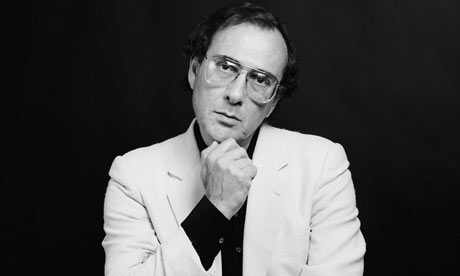
Harold Pinter

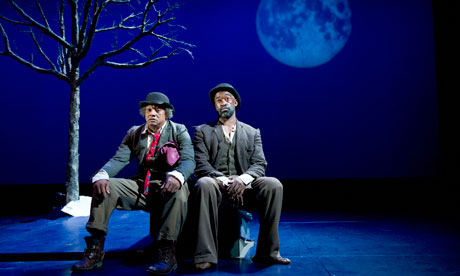
Waiting For Godot by Samuel Beckett

Copy of Play

A full text free copy of Waiting for Godot can be found online here.

Reviews

New York Times, 1956

"you can expect witness to the strange power this drama has to convey the impression of some melancholy truths about the hopeless destiny of the human race."
For full review click here

Theatre Journal, 1999

"Waiting for Godot consists almost wholly of eloquence deployed against the torments of waiting."
For full review click here.

The Observer, 2009

"For the text is the perfect statement of futility and redemption, of lying in the gutter but looking at the stars, and audiences who seek the pattern of their own fears will find it for themselves."
For full review click here.

The Arts Fuse, 2013

"it accentuates the aspects of the human spirit that make due with scraps, that survives the unthinkable with a residue of resilience."
For full review click here.

What are they waiting for? Who is Godot?

"It's fairly obvious Godot can be anything you want. The great thing Beckett did was to say there is such a thing as metaphorical theatre. Godot's a metaphor for religions, philosophy, belief, every kind of thing you can think of, but it never arrives. We do die, however - this we know. But Sam didn't talk about death, he didn't give lectures about what his play meant."

Production Photos
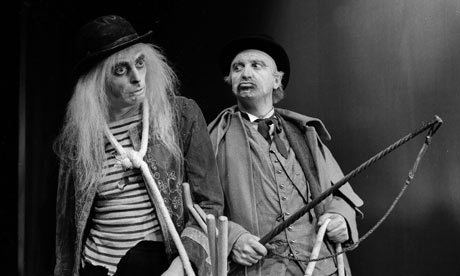
Original Production, 1956


West Yorkshire Playhouse, 2012


McNeese State University, 2010
SCENA Theatre, 2008

Sunday, October 27, 2013

Surrealism


ABOUT

Surrealism originated in the late 1910s and early '20s as a literary movement that experimented with a new mode of expression called automatic writing, or automatism, which sought to release the unbridled imagination of the subconscious. Officially consecrated in Paris in 1924 with the publication of the Manifesto of Surrealism by the poet and critic André Breton (1896–1966), Surrealism became an international intellectual and political movement. Breton, a trained psychiatrist, along with French poets Louis Aragon (1897–1982), Paul Éluard (1895–1952), and Philippe Soupault (1897–1990), were influenced by the psychological theories and dream studies of Sigmund Freud (1856–1939) and the political ideas of Karl Marx (1818–1883). Using Freudian methods of free association, their poetry and prose drew upon the private world of the mind, traditionally restricted by reason and societal limitations, to produce surprising, unexpected imagery. The cerebral and irrational tenets of Surrealism find their ancestry in the clever and whimsical disregard for tradition fostered by Dadaism a decade earlier.

Surrealist poets were at first reluctant to align themselves with visual artists because they believed that the laborious processes of painting, drawing, and sculpting were at odds with the spontaneity of uninhibited expression. However, Breton and his followers did not altogether ignore visual art. They held high regard for artists such as Giorgio de Chirico (1888–1978), Pablo Picasso (1881–1973), Francis Picabia (1879–1953), and Marcel Duchamp (1887–1968) because of the analytic, provocative, and erotic qualities of their work. For example, Duchamp's conceptually complex Bride Stripped Bare by Her Bachelors, Even (The Large Glass) (1915–23; Philadelphia Museum of Art) was admired by Surrealists and is considered a precursor to the movement because of its bizarrely juxtaposed and erotically charged objects. In 1925, Breton substantiated his support for visual expression by reproducing the works of artists such as Picasso in the journal La Révolution Surréaliste and organizing exhibitions that prominently featured painting and drawing. 

The visual artists who first worked with Surrealist techniques and imagery were the German Max Ernst (1891–1976), the Frenchman André Masson (1896–1987), the Spaniard Joan Miró (1893–1983), and the American Man Ray (1890–1976). Masson's free-association drawings of 1924 are curving, continuous lines out of which emerge strange and symbolic figures that are products of an uninhibited mind. Breton considered Masson's drawings akin to his automatism in poetry. The Potato (1999.363.50) of 1928 by Miró uses comparable organic forms and twisted lines to create an imaginative world of fantastic figures. 

About 1937, Ernst, a former Dadaist, began to experiment with two unpredictable processes called decalcomania and grattage. Decalcomania is the technique of pressing a sheet of paper onto a painted surface and peeling it off again, while grattage is the process of scraping pigment across a canvas that is laid on top of a textured surface. He used a combination of these techniques in The Barbarians (1999.363.21) of 1937. This composition of sparring anthropomorphic figures in a deserted postapocalyptic landscape exemplifies the recurrent themes of violence and annihilation found in Surrealist art. 

In 1927, the Belgian artist René Magritte (1898–1967) moved from Brussels to Paris and became a leading figure in the visual Surrealist movement. Influenced by de Chirico's paintings between 1910 and 1920, Magritte painted erotically explicit objects juxtaposed in dreamlike surroundings. His work defined a split between the visual automatism fostered by Masson and Miró (and originally with words by Breton) and a new form of illusionistic Surrealism practiced by the Spaniard Salvador Dalí (1904–1989), the Belgian Paul Delvaux (1897–1994), and the French-American Yves Tanguy (1900–1955). In The Eternally Obvious (2002.456.12a-f), Magritte's artistic display of a dismembered female nude is emotionally shocking. In The Satin Tuning Fork (1999.363.80), Tanguy fills an illusionistic space with unidentifiable, yet sexually suggestive, objects rendered with great precision. The painting's mysterious lighting, long shadows, deep receding space, and sense of loneliness also recall the ominous settings of de Chirico. 

In 1929, Dalí moved from Spain to Paris and made his first Surrealist paintings. He expanded on Magritte's dream imagery with his own erotically charged, hallucinatory visions. In The Accommodations of Desire (1999.363.16) of 1929, Dalí employs Freudian symbols, such as ants, to symbolize his overwhelming sexual desire. In 1930, Breton praised Dalí's representations of the unconscious in the Second Manifesto of Surrealism. They became the main collaborators on the review Minotaure (1933–39), a primarily Surrealist-oriented publication founded in Paris. 

The organized Surrealist movement in Europe dissolved with the onset of World War II. Breton, Dalí, Ernst, Masson, and others, including the Chilean artist Matta (1911–2002), who first joined the Surrealists in 1937, left Europe for New York. The movement found renewal in the United States at Peggy Guggenheim's (1898–1979) gallery, Art of This Century, and the Julien Levy Gallery. In 1940, Breton organized the fourth International Surrealist Exhibition in Mexico City, which included the Mexicans Frida Kahlo (1907–1954) and Diego Rivera (1886–1957) (although neither artist officially joined the movement). Surrealism's surprising imagery, deep symbolism, refined painting techniques, and disdain for convention influenced later generations of artists, including Joseph Cornell (1903–1972) and Arshile Gorky (1904–1948), the latter whose work formed a continuum between Surrealism and Abstract Expressionism.


ART

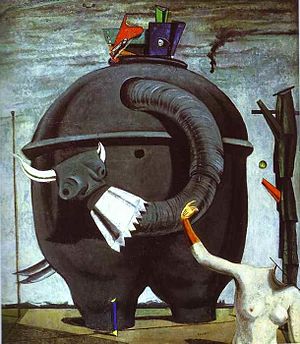
Max Ernst, The Elephant Celebes (1921)


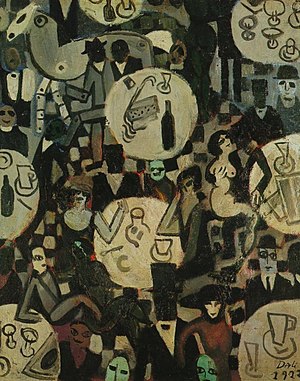
Cabaret Scene, Salvador Dali, 1922

Salvador Dalí, The Persistence of Memory (1931)

Yves Tanguy, Indefinite Divisibility, 1942

THEATRE

Classic Theatre's Company's UBU ROI, 2013


A Dream Play trailor


Expressionism


ABOUT

"Expressionism is the movement in fine arts that emphasized the expression of inner experience rather than solely realistic portrayal, seeking to depict not objective reality, but the subjective emotions and responses that objects and events arouse in the artist." (Nicholas Pioch, WebMuseum).

"In Germany, Expressionism became synonymous with the rejection of the Western ideals of naturalism and came to embody the very idea of modern and revolutionary art." (Art in Context)

Expressionism represents the artist’s personality and interior perception imposed on the visual reality of the objects depicted. The objects in Expressionism paintings are often distorted, painted in vivid colors, and are composed of strong, bold lines. Expressionism incorporates other styles such as Symbolism, Surrealism, Cubism, and Abstraction. Its roots can be found in both Medieval Art and African Art. Expressionism also revived the ancient German tradition of woodcut, but as a form of personal expression.

The Expressionism movement was centered in Germany from 1905 until the time of its destruction in the late 1930s. The end of the first world war in 1918 brought the disappearance of the ruling dynasties from the political scene and Germany became a Republic. The collapse of the structure of ruling power was expected to bring with it a new world. But the artistic and political ideology of Expressionism peaked in 1923. By the end of that year, politically motivated attacks against modern art had begun.


Synopsis

Expressionism emerged simultaneously in various cities across Germany as a response to a widespread anxiety about humanity's increasingly discordant relationship with the world and accompanying lost feelings of authenticity and spirituality. In part a reaction against Impressionism and academic art, Expressionism was inspired most heavily by the Symbolist currents in late nineteenth-century art. Vincent van Gogh, Edvard Munch, and James Ensor proved particularly influential to the Expressionists, encouraging the distortion of form and the deployment of strong colors to convey a variety of anxieties and yearnings. The classic phase of the Expressionist movement lasted from approximately 1905 to 1920 and spread throughout Europe. Its example would later inform Abstract Expressionism, and its influence would be felt throughout the remainder of the century in German art. It was also a critical precursor to the Neo-Expressionist artists of the 1980s.

Key Ideas

The arrival of Expressionism announced new standards in the creation and judgment of art. Art was now meant to come forth from within the artist, rather than from a depiction of the external visual world, and the standard for assessing the quality of a work of art became the character of the artist's feelings rather than an analysis of the composition.
Expressionist artists often employed swirling, swaying, and exaggeratedly executed brushstrokes in the depiction of their subjects. These techniques were meant to convey the turgid emotional state of the artist reacting to the anxieties of the modern world.
Through their confrontation with the urban world of the early twentieth century, Expressionist artists developed a powerful mode of social criticism in their serpentine figural renderings and bold colors. Their representations of the modern city included alienated individuals - a psychological by-product of recent urbanization - as well as prostitutes, who were used to comment on capitalism's role in the emotional distancing of individuals within cities.

Beginnings

With the turn of the century in Europe, shifts in artistic styles and vision erupted as a response to the major changes in the atmosphere of society. New technologies and massive urbanization efforts altered the individual's worldview, and artists reflected the psychological impact of these developments by moving away from a realistic representation of what they saw toward an emotional and psychological rendering of how the world affected them. The roots of Expressionism can be traced to certain Post-Impressionist artists like Edvard Munch in Norway, as well as Gustav Klimt in the Vienna Secession, and finally emerged in Germany in 1905.
Edvard Munch in Norway
The late nineteenth-century Norwegian Post-Impressionist painter Edvard Munch emerged as an important source of inspiration for the Expressionists. His vibrant and emotionally charged works opened up new possibilities for introspective expression. In particular, Munch's frenetic canvases expressed the anxiety of the individual within the newly modernized European society; his famous painting The Scream (1893) evidenced the conflict between spirituality and modernity as a central theme of his work. By 1905 Munch's work was well known within Germany and he was spending much of his time there as well, putting him in direct contact with the Expressionists.
Gustav Klimt in Austria
Another figure in the late nineteenth century that had an impact upon the development of Expressionism was Gustav Klimt, who worked in the Austrian Art Nouveau style of the Vienna Secession. Klimt's lavish mode of rendering his subjects in a bright palette, elaborately patterned surfaces, and elongated bodies was a step toward the exotic colors, gestural brushwork, and jagged forms of the later Expressionists. Klimt was a mentor to painter Egon Schiele, and introduced him to the works of Edvard Munch and Vincent van Gogh, among others, at an exhibition of their work in 1909.

The Advent of Expressionism in Germany

Although it included various artists and styles, Expressionism first emerged in 1905, when a group of four German architecture students who desired to become painters - Ernst Ludwig Kirchner, Fritz Bleyl, Karl Schmidt-Rottluff, and Erich Heckel - formed the group Die Brücke (the Bridge) in the city of Dresden. A few years later, in 1911, a like-minded group of young artists formed Der Blaue Reiter (The Blue Rider) in Munich, after the rejection of Wassily Kandinsky's painting The Last Judgment (1910) from a local exhibition. In addition to Kandinsky, the group included Franz Marc, Paul Klee, and August Macke, among others, all of whom made up the loosely associated group.

The Term "Expressionism"

The term "Expressionism" is thought to have been coined in 1910 by Czech art historian Antonin Matejcek, who intended it to denote the opposite of Impressionism. Whereas the Impressionists sought to express the majesty of nature and the human form through paint, the Expressionists, according to Matejcek, sought only to express inner life, often via the painting of harsh and realistic subject matter. It should be noted, however, that neither Die Brücke, nor similar sub-movements, ever referred to themselves as Expressionist, and, in the early years of the century, the term was widely used to apply to a variety of styles, including Post-Impressionism.

Concepts and Styles

Die Brücke: Kirchner, Schmidt-Rottluff, Heckel, and Bleyl
Influenced by artists such as Munch, van Gogh, and Ensor, the members of the Dresden-based Die Brücke group sought to convey raw emotion through provocative images of modern society. They depicted scenes of city dwellers, prostitutes, and dancers in the city's streets and nightclubs, presenting the decadent underbelly of German society. In works such as Kirchner's Street, Berlin (1913), they emphasized the alienation inherent to modern society and the loss of spiritual communion between individuals in urban culture; fellow city dwellers are distanced from one another, acting as mere commodities, as in the prostitutes at the forefront of Kirchner's composition.
Unlike the pastoral scenes of Impressionism and the academic drawings of Neoclassicism, Die Brücke artists used distorted forms and jarring, unnatural pigments to elicit the viewer's emotional response. The group was similarly united by a reductive and primitive aesthetic, a revival of older media and medieval German art, in which they used graphic techniques such as woodblock printing to create crude, jagged forms.
The group published a woodcut broadsheet in 1906, called Programme, to accompany their first exhibition. It summarized their break with prevailing academic traditions calling for a freer, youth-oriented aesthetic. Although mostly written by Kirchner, this poster served as manifesto stating the ideals of Die Brücke. The members of Die Brücke drew largely from the writings of German philosopher Friedrich Nietzsche in terms of both their artistic project and their philosophical grounding. Their name came from a quote from Thus Spoke Zarathustra (1883-85) that states, "What is great in man is that he is a bridge and not an end." The group exhibited and collaborated through 1913, when Kirchner penned Chronik der Brücke (Brücke Chronicle) and the collective effectively dissolved.
Der Blaue Reiter: Kandinsky, Macke, Klee, and Marc
The artists of Der Blaue Reiter group shared an inclination towards abstraction, symbolic content, and spiritual allusion. They sought to express the emotional aspects of being through highly symbolic and brightly colored renderings. Their name emerged from the symbol of the horse and rider, derived from one of Wassily Kandinsky's paintings; for Kandinsky, the rider symbolized the transition from the tangible world into the spiritual realm and thus acted as a metaphor for artistic practice. For other members such as Franz Marc, Paul, Klee, and Auguste Macke, this notion became a central principle for transcending realistic depiction and delving into abstraction.
Although Der Blaue Reiter never published a manifesto, its members were united by their aesthetic innovations, which were influenced by medieval and primitivist art forms, Cubism, and Fauvism. However, the group itself was short-lived; with the outbreak of World War I in 1914, Franz Marc and Auguste Macke were drafted into German military service and were killed soon after. The Russian members of the group - Wassily Kandinsky, Alexej von Jawlensky, and others - were all forced to return home. Der Blaue Reiter dissolved immediately thereafter.

French Expressionism: Rouault, Soutine, and Chagall
Expressionism's elasticity has meant that many artists beyond Germany's borders have been identified with the style. Georges Rouault, the French artist sometimes described as an Expressionist, may have influenced the Germans, rather than the other way around. He learned his vivid use of color and distortion of form from Fauvism, and, unlike his German Expressionist counterparts, Rouault expressed an affinity for his Impressionist predecessors, particularly for the work of Edgar Degas. He is well known for his devotion to religious subjects, and particularly for his many depictions of the crucifixion, rendered in rich color and heavy layers of paint.
The Russian-French Jewish artist Marc Chagall drew upon currents from Cubism, Fauvism, and Symbolism to create his own brand of Expressionism in which he often depicted dreamy scenes of his Belarusian hometown, Vitebsk. While in Paris during the height of the modernist avant-garde, Chagall developed a visual language of eccentric motifs: "ghostly figures floating in the sky, the gigantic fiddler dancing on miniature dollhouses, the livestock and transparent wombs and, within them, tiny offspring sleeping upside down." In 1914, his work was exhibited in Berlin, and had an impact on the German Expressionists extending beyond World War I. He never associated his work with a specific movement, and considered his repertoire to be a vocabulary of images meaningful to himself, but they inspired many, including the Surrealists. Pablo Picasso remarked in the 1950s, "When Matisse dies, Chagall will be the only painter left who understands what colour really is."
Chaim Soutine, the Russian-Jewish, Paris-based painter, was a major proponent of the development of Parisian Expressionism. He synthesized elements from Impressionism, the French Academic tradition, and his own personal vision into an individualized technique and version of the style. The artist's expressive style has proved highly influential on subsequent generations.

Austrian Expressionism: Kokoschka and Schiele
Austrian artists such as Oskar Kokoschka and Egon Schiele, were inspired by German Expressionism, but interpreted the style in their individual and personalized manners never forming an official association like the Germans. Kokoschka and Schiele sought to express the decadence of modern Austria through similarly expressive representations of the human body; by sinuous lines, garish colors, and distorted figures, both artists imbued their subjects with highly sexual and psychological themes. Although Kokschka and Schiele were the central proponents of the movement in Austria, Kokoschka became increasingly involved in German Expressionist circles; he left Austria and moved to Germany in 1910. Initially Kokoschka worked in a Viennese Art Nouveau style, but starting in 1908 he instinctively worked as an Expressionist, passionately seeking to expose an inner sensibility of the sitter in his early portraits. Schiele left Vienna in 1912 but remained in Austria, where he worked and exhibited until his death in the worldwide influenza epidemic of 1918.

Further Developments and Legacy

While certain artists rejected Expressionism, others would continue to expand upon its innovations as a style. For example, in the 1920s, Kandinsky transitioned to completely non-objective paintings and watercolors, which emphasized color balance and archetypal forms, rather than figurative representation. However, Expressionism would have its most direct impact in Germany and would continue to shape its art for decades afterwards. After World War I, Expressionism began to lose impetus and fragment. The Neue Sachlichkeit (New Objectivity) movement developed as a direct response to the highly emotional tenets of Expressionism, while the Neo-Expressionists emerged in Germany and then in the United States much later in the twentieth century, reprising the earlier Expressionist style.

New Objectivity: Dix, Grosz and Beckmann
Already by 1918, the Dada manifesto claimed, "Expressionism...no longer has anything to do with the efforts made by active people." But its ethos would have a vivid afterlife; it was crucial in the early formation of artists Otto Dix, George Grosz, and Max Beckmann, who together formed the movement known as the Neue Sachlichkeit (New Objectivity). These artists sought, as the name suggests, an unsentimental and objective approach to artistic production. Their naturalistic renderings of individuals and urban scenes highlighted this new aesthetic and paralleled the general attitude of practicality that characterized Weimar culture.

Neo-Expressionism: Baselitz, Kiefer, and Schnabel
The emergence of Georg Baselitz's paintings of layered, vibrant colors and distorted figures in the 1960s, and of Anselm Kiefer's images buried amidst thick impasto built up from a variety of materials on the canvas in the 1970s, signaled an important and influential revival of the style within Germany, which would eventually culminate in a global Neo-Expressionist movement in the 1980s. Artists in New York City, like Julian Schnabel, also employed thick layers of paint, unnatural color palettes and gestural brushwork to hearken back to the Expressionist movement earlier in the twentieth century.
The original Expressionist movement's ideas about spirituality, primitivism, and the value of abstract art would also be hugely influential on an array of unrelated movements, including Abstract Expressionism. The Expressionists' metaphysical outlook and instinctive discomfort with the modern world impelled them to antagonistic attitudes that would continue to be characteristic of various avant-garde movements throughout the century.

QUOTES

"With faith in progress and in a new generation of creators and spectators we call together all youth. As youth, we carry the future and want to create for ourselves freedom of life and of movement against the long-established older forces. Everyone who reproduces that which drives him to creation with directness and authenticity belongs to us." 
- Ernst Ludwig Kirchner, from a woodcut broadsheet that accompanied the Die Brücke exhibition at the Seifert factory, Dresden, 1906

"The German artist creates out of his imagination, inner vision, the forms of visible nature are to him only a symbol." 
- Ernst Ludwig Kirchner

"Art is nothing but the expression of our dream; the more we surrender to it the closer we get to the inner truth of things, our dream-life, the true life that scorns questions and does not see them." 
- Franz Marc

"I really feel a pressure to create something that is as strong as possible. The war has really swept away everything form the past. Everything seems weak to me and I suddenly see things in their terrible power. I never liked the type of art that was simply appealing to the eye, and I have the fundamental feeling that we need still stronger forms, so strong, that they can withstand the force of the crazed masses." 
- Karl Schmidt-Rottluff

"True dreams and visions should be as visible to the artist as the phenomena of the objective." 
- Oskar Kokoschka

"Incomprehensible ideas express themselves in comprehensible forms...Form is a mystery to us for it is the expression of mysterious powers...Our senses are our bridge between the incomprehensible and the comprehensible." 
- August Macke


ART


The Old King, Georges Rouault, 1936

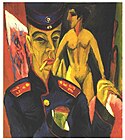
Ernst Ludwig Kirchner, Self-Portrait as a Soldier, 1915


Portrait of a Young Girl, Oscar Kokoschka, 1913
The Scream by Edvard Munch (1893)

Theatre

Expressionist drama felt no commitment to the depiction of everyday reality; it was subjective and arbitrary. In the wake of Strindberg’s A Dream Play (1907), it often featured dream imagery. Action as well as language throbbed with nervous energy. The unities were discarded, the narrative line frequently being a series of ‘stations’ rather than a well-knit plot – an approach which, through the work of Piscator and Brecht, gave rise to epic theatre. Diction, too, became fragmented: grammar was violated and sentences collapsed; there were sudden lyrical outbursts; speech became a cry. These new demands called for a new acting style. The playwright Paul Kornfeld advised: ‘Let not the actor... behave as though the thoughts and words he has to express have only arisen in him at the very moment in which he recites them... Let him dare to stretch his arms out wide and with a sense of soaring speak as he has never spoken in life; let him not be an imitator or seek his model in a world alien to the actor.’

Such plays could not be staged by conventional methods. A new approach to stage design revealed the close links between expressionism in drama and the visual arts. Sets became simplified, angled, distorted, fantasticated. The stage was conceived as a space rather than a picture. Spotlights – as in Jürgen Fehling’s notable production in 1921 of Toller’s Masses and Man created the acting areas and shifted the focus from one spot to another; some expressionist lighting techniques had an impact on the cinema of the period.


Machinal


Futurism

ABOUT

In the early 1900s, a group of young and rebellious Italian writers and artists emerged determined to celebrate industrialization. They were frustrated by Italy’s declining status and believed that the “Machine Age” would result in an entirely new world order and even a renewed consciousness. Filippo Tommaso Marinetti, the ringleader of this group, called the movement Futurism. Its members sought to capture the idea of modernity, the sensations and aesthetics of speed, movement, and industrial development.

A Manifesto
Marinetti launched Futurism in 1909 with the publication his “Futurist manifesto” on the front page of the French newspaper Le Figaro. The manifesto set a fiery tone. In it Marinetti lashed out against cultural tradition (passatismo, in Italian) and called for the destruction of museums, libraries, and feminism. Futurism quickly grew into an international movement and its participants issued additional manifestos for nearly every type of art: painting, sculpture, architecture, music, photography, cinema—even clothing. 

The Futurist painters—Umberto Boccioni, Carlo Carrà, Luigi Russolo, Gino Severini, and Giacomo Balla—signed their first manifesto in 1910 (the last named his daughter Elica—Propeller!). Futurist painting had first looked to the color and the optical experiments of the late 19th century, but in the fall of 1911, Marinetti and the Futurist painters visited the Salon d’Automne in Paris and saw Cubism in person for the first time. Cubism had an immediate impact that can be seen in Boccioni’s Materia of 1912 for example. Nevertheless, the Futurists declared their work to be completely original. 

Dynamism of Bodies in Motion
The Futurists were particularly excited by the works of late 19th-century scientist and photographer Étienne-Jules Marey, whose chronophotographic (time-based) studies depicted the mechanics of animal and human movement.  

A precursor to cinema, Marey’s innovative experiments with time-lapse photography were especially influential for Balla. In his painting Dynamism of a Dog on a Leash, the artist playfully renders the dog's (and dog walker's) feet as continuous movements through space over time.

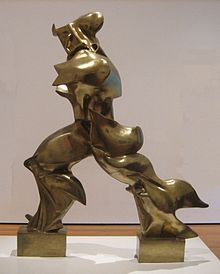
Entranced by the idea of the “dynamic,” the Futurists sought to represent an object’s sensations, rhythms and movements in their images, poems and manifestos. Such characteristics are beautifully expressed in Boccioni’s most iconic masterpiece, Unique Forms of Continuity in Space (see above). 

The choice of shiny bronze lends a mechanized quality to Boccioni's sculpture, so here is the Futurists’ ideal combination of human and machine. The figure’s pose is at once graceful and forceful, and despite their adamant rejection of classical arts, it is also very similar to the Nike of Samothrace.

Politics & War
Futurism was one of the most politicized art movements of the twentieth century. It merged artistic and political agendas in order to propel change in Italy and across Europe. The Futurists would hold what they called serate futuriste, or Futurist evenings, where they would recite poems and display art, while also shouting politically charged rhetoric at the audience in the hope of inciting riot. They believed that agitation and destruction would end the status quo and allow for the regeneration of a stronger, energized Italy.

These positions led the Futurists to support the coming war, and like most of the group’s members, leading painter Boccioni enlisted in the army during World War I. He was trampled to death after falling from a horse during training. After the war, the members’ intense nationalism led to an alliance with Benito Mussolini and his National Fascist Party. Although Futurism continued to develop new areas of focus (aeropittura, for example) and attracted new members—the so-called “second generation” of Futurist artists—the movement’s strong ties to Fascism has complicated the study of this historically significant art.


Synopsis
The most important Italian avant-garde art movement of the 20th century, Futurism celebrated advanced technology and urban modernity. Committed to the new, its members wished to destroy older forms of culture and to demonstrate the beauty of modern life - the beauty of the machine, speed, violence and change. Although the movement did foster some architecture, most of its adherents were artists who worked in traditional media such as painting and sculpture, and in an eclectic range of styles inspired by Post-Impressionism. Nevertheless, they were interested in embracing popular media and new technologies to communicate their ideas. Their enthusiasm for modernity and the machine ultimately led them to celebrate the arrival of the First World War. By its end the group was largely spent as an important avant-garde, though it continued through the 1920s, and, during that time several of its members went on to embrace Fascism, making Futurism the only twentieth century avant-garde to have embraced far right politics.

Key Points
The Futurists were fascinated by the problems of representing modern experience, and strived to have their paintings evoke all kinds of sensations - and not merely those visible to the eye. At its best, Futurist art brings to mind the noise, heat and even the smell of the metropolis.
Unlike many other modern art movements, such as Impressionism and Pointillism, Futurism was not immediately identified with a distinctive style. Instead its adherents worked in an eclectic manner, borrowing from various aspects of Post-Impressionism, including Symbolism and Divisionism. It was not until 1911 that a distinctive Futurist style emerged, and then it was a product of Cubist influence.
The Futurists were fascinated by new visual technology, in particular chrono-photography, a predecessor of animation and cinema that allowed the movement of an object to be shown across a sequence of frames. This technology was an important influence on their approach to showing movement in painting, encouraging an abstract art with rhythmic, pulsating qualities.

Beginnings
Futurism began its transformation of Italian culture on February 20th, 1909, with the publication of the Futurist Manifesto, authored by writer Filippo Tommaso Marinetti. Umberto Boccioni (left) and Filippo Tommaso Marinetti in 1910 It appeared on the front page of Le Figaro, which was then the largest circulation newspaper in France, and the stunt signaled the movement's desire to employ modern, popular means of communication to spread its ideas. The group would issue more manifestos as the years passed, but this summed up their spirit, celebrating the "machine age", the triumph of technology over nature, and opposing earlier artistic traditions. Marinetti's ideas drew the support of artists Umberto Boccioni, Giacomo Balla, Gino Severini, and Carlo Carrà, who believed that they could be translated into a modern, figurative art which explored properties of space and movement. The movement initially centered in Milan, but it spread quickly to Turin and Naples, and over subsequent years Marinetti vigorously promoted it abroad.

Concepts and Styles
The Italian group was slow to develop a distinct style. In the years prior to the emergence of the movement, its members had worked in an eclectic range of styles inspired by Post-Impressionism, and they continued to do so. Severini was typical in his interest in Divisionism, which involved breaking down light and color into a series of stippled dots and stripes, and fracturing the picture plane into segments to achieve an ambiguous sense of depth. Divisionism was rooted in the color theory of the 19th century, and Pointillist work of painters such as Georges Seurat.
In 1911, Futurist paintings were exhibited in Milan at the Mostra d'arte libera, and invitations were extended to "all those who want to assert something new, that is to say far from imitations, derivations and falsifications." The paintings featured threadlike brushstrokes and highly keyed color that depicted space as fragmented and fractured. Subjects and themes focused on technology, speed, and violence, rather than portraits or simple landscapes. Among the paintings was Boccioni's The City Rises (1910), a picture which can claim to be the first Futurist painting by virtue of its advanced, Cubist-influenced style. Public reaction was mixed. French critics from literary and artistic circles expressed hostility, while many praised the innovative content.
Boccioni's encounter with Cubist painting in Paris had an important influence on him, and he carried this back to his peers in Italy. Nevertheless, the Futurists claimed to reject the style, since they believed it was too preoccupied by static objects, and not enough by the movement of the modern world. It was their fascination with movement that led to their interest in chrono-photography. Balla was particularly enthusiastic about the technology, and his pictures sometimes evoke fast-paced animation, with objects blurred by movement. As stated by the Technical Manifesto of Futurist Painting, "On account of the persistency of an image upon the retina, moving objects constantly multiply themselves; their form changes like rapid vibrations in their mad career. Thus a running horse has not four legs, but twenty, and their movements are triangular." Rather than perceiving an action as a performance of a single limb, Futurists viewed action as the convergence in time and space of multiple extremities.
Futurist artists in 1913; from left - Decio Cinti, Luigi Russolo, Armando Mazza, Filippo Tommaso Marinetti, Paolo Buzzi, and Umberto Boccioni

Later Developments
In 1913, Boccioni used sculpture to further articulate Futurist dynamism. Unique Forms of Continuity in Space (1913) exemplifies vigorous action as well as the relationship between object and environment. The piece was a breakthrough for the Futurist movement, but after 1913 the movement began to break apart as its members developed their own personal positions. In 1915, Italy entered World War I; by its end, Boccioni and the Futurist architect Antonia Sant'Elia perished. Following the war, the movement's center shifted from Milan to Rome; Severini continued to paint in the distinctive Futurist style, and the movement remained active in the 1920s, but the energy had passed from it.
Nevertheless, Futurism sparked important developments outside Italy. A synthesis of Parisian Cubism and Italian Futurism was particularly influential in Russia from around 1912 until 1920, inspiring artists including Kazimir Malevich, Liubov Popova, Natalia Goncharova and David Burliuk. The developments in Russia made the movement very distinct from the Italian strain, and different aspects of it are often described as Rayonist, or Cubo-Futurist. Cubo-Futurism was also an influence on English art, where it gave rise to the Vorticist movement, which embraced philosopher T.E. Hulme, poet Ezra Pound, and artists Christopher Nevinson, Wyndham Lewis, David Bomberg and Jacob Epstein. Although the impact of Italian Futurism was concentrated in the visual arts, it did inspire artists in other media: Vladimir Mayakovsky was important in developing a Futurist literature in Russia; the Italian architect Antonio Sant'Elia developed a Futurist architecture, and is said to have penned a manifesto on the subject (his designs may have influenced the sets of Ridley Scott's film Bladerunner (1982)); and Luigi Russolo shifted from painting to creating musical instruments, and later wrote the manifesto "the Art of Noises" (1913), which has been a significant reference point for avant-garde music ever since. Although much of the energy had left the movement by the 1920s, the Futurist aesthetic also became part of the mix of modernist styles that inspired Art Deco.

QUOTES
"We want to fight ferociously against the fanatical, unconscious and snobbish religion of the past, which is nourished by the evil influence of museums. We rebel against the supine admiration of old canvases, old statues and old objects, and against the enthusiasm for all that is worm-eaten, dirty and corroded by time; we believe that the common contempt for everything young, new and palpitating with life is unjust and criminal." 
- Filippo Marinetti

"If we paint the phases of an uprising, the crowd bristling with fists and noisy cavalry assaults will be translated on the canvas into bands of lines corresponding to all the forces in conflict, following the painting's laws of general violence. These lines of force must envelop the spectator and carry him away; he himself must be in some way obliged to grapple with the figures in the picture. All the objects, according to physical transcendentalism, tend towards the infinite through their force-lines, to bring the work of art back to true painting. We interpret nature by presenting these lines on the canvas as the origins or prolongations of the rhythms which the objects impress on our sensibilities." 
- Apollonio


MANIFESTO

We want to sing the love of danger, the habit of energy and rashness.
The essential elements of our poetry will be courage, audacity and revolt.
Literature has up to now magnified pensive immobility, ecstasy and slumber. We want to exalt movements of aggression, feverish sleeplessness, the double march, the perilous leap, the slap and the blow with the fist.
We declare that the splendor of the world has been enriched by a new beauty: the beauty of speed. A racing automobile with its bonnet adorned with great tubes like serpents with explosive breath ... a roaring motor car which seems to run on machine-gun fire, is more beautiful than the Victory of Samothrace.
We want to sing the man at the wheel, the ideal axis of which crosses the earth, itself hurled along its orbit.
The poet must spend himself with warmth, glamour and prodigality to increase the enthusiastic fervor of the primordial elements.
Beauty exists only in struggle. There is no masterpiece that has not an aggressive character. Poetry must be a violent assault on the forces of the unknown, to force them to bow before man.
We are on the extreme promontory of the centuries! What is the use of looking behind at the moment when we must open the mysterious shutters of the impossible? Time and Space died yesterday. We are already living in the absolute, since we have already created eternal, omnipresent speed.
We want to glorify war — the only cure for the world — militarism, patriotism, the destructive gesture of the anarchists, the beautiful ideas which kill, and contempt for woman.
We want to demolish museums and libraries, fight morality, feminism and all opportunist and utilitarian cowardice.
We will sing of the great crowds agitated by work, pleasure and revolt; the multi-colored and polyphonic surf of revolutions in modern capitals: the nocturnal vibration of the arsenals and the workshops beneath their violent electric moons: the gluttonous railway stations devouring smoking serpents; factories suspended from the clouds by the thread of their smoke; bridges with the leap of gymnasts flung across the diabolic cutlery of sunny rivers: adventurous steamers sniffing the horizon; great-breasted locomotives, puffing on the rails like enormous steel horses with long tubes for bridle, and the gliding flight of aeroplanes whose propeller sounds like the flapping of a flag and the applause of enthusiastic crowds.

For full Manifesto click here


ART

Natalia Goncharova, Cyclist, 1913

Umberto Boccioni, Unique Forms of Continuity in Space (1913)

Tullio Crali (1910-2000), Bombardamento Aereo, 1932

THEATRE

Examples of Futuristic Sintesi


FROM THE MANIFESTO OF THE FUTURIST SYNTHETIC THEATRE

The dramatic 'synthesis', which will take the place of the traditional play, will be 'autonomous, unreal, and alogical'. Although elements drawn from reality will be used, they will be combined according to whim, and the synthesis will resemble nothing but itself. With color, forms, sounds and noises, it will, like the works of Futurist painters and musicians, assault the nerves.... The spectators will be made to 'forget the monotony of everyday life' through a 'labyrinth of sensations' characterized by the most exasperating originality combined in unexpected ways.

Anticipating the Surrealists, the Futurists declared that discoveries of the subconscious must be brought to the stage. The entertainment would 'symphonize' the feelings of the public, exploring and revealing those feelings in every possible way.


Dadaism

ABOUT

Dada emerged amid the brutality of World War I (1914–18)—a conflict that claimed the lives of eight million military personnel and an estimated equal number of civilians. This unprecedented loss of human life was a result of trench warfare and technological advances in weaponry, communications, and transportation systems.
For the disillusioned artists of the Dada movement, the war merely confirmed the degradation of social structures that led to such violence: corrupt and nationalist politics, repressive social values, and unquestioning conformity of culture and thought. From 1916 until the mid-1920s, artists in Zurich, New York, Cologne, Hanover, and Paris declared an all-out assault against not only on conventional definitions of art, but on rational thought itself. “The beginnings of Dada,” poet Tristan Tzara recalled, “were not the beginnings of art, but of disgust.”1 Dada’s subversive and revolutionary ideals emerged from the activities of a small group of artists and poets in Zurich, eventually cohering into a set of strategies and philosophies adopted by a loose international network of artists aiming to create new forms of visual art, performance, and poetry as well as alternative visions of the world. The artists affiliated with Dada did not share a common style or practice so much as the wish, as expressed by French artist Jean (Hans) Arp, “to destroy the hoaxes of reason and to discover an unreasoned order.”2
For Dada artists, the aesthetic of their work was considered secondary to the ideas it conveyed. “For us, art is not an end in itself,” wrote Dada poet Hugo Ball, “but it is an opportunity for the true perception and criticism of the times we live in.” Dadaists both embraced and critiqued modernity, imbuing their works with references to the technologies, newspapers, films, and advertisements that increasingly defined contemporary life. They were also experimental, provocatively re-imagining what art and art making could be. Using unorthodoxmaterials and chance-based procedures, they infused their work with spontaneity and irreverence. Wielding scissors and glue, Dada artists innovated withcollage andphotomontage. Still others explored games, experimental theater, and performance. A central figure, Marcel Duchamp, declared common, manufactured goods to be “readymade” artworks, radically challenging the notion of a work of art as something beautiful made by a technically skilled artist.
Participants claimed various, often humorous definitions of “Dada”—“Dada is irony,” “Dada is anti-art,” “Dada will kick you in the behind”—though the word itself is a nonsense utterance. As the story goes, the name Dada was either chosen at random by stabbing a knife into a dictionary, or consciously selected for a variety of connotations in different languages—French for “hobbyhorse” or Russian for “yes, yes.”
Synopsis
Dada was an artistic and literary movement that began in 1916 in Zurich, Switzerland. It arose as a reaction to World War I, and the nationalism, and rationalism, which many thought had brought war about. Influenced by ideas and innovations from several early avant-gardes - Cubism, Futurism, Constructivism, and Expressionism - its output was wildly diverse, ranging from performance art to poetry, photography, sculpture, painting and collage. Dada's aesthetic, marked by its mockery of materialistic and nationalistic attitudes, proved a powerful influence on artists in many cities, including Berlin, Hanover, Paris, New York and Cologne, all of which generated their own groups. The movement is believed to have dissipated with the arrival of Surrealist in France.
Key Ideas
Dada was born out of a pool of avant-garde painters, poets and filmmakers who flocked to neutral Switzerland before and during WWI.
The movement came into being at the Cabaret Voltaire in Zurich in February 1916. The Cabaret was named after the eighteenth century French satirist, Voltaire, whose play Candide mocked the idiocies of his society. As Hugo Ball, one of the founders of Zurich Dada wrote, "This is our Candide against the times."
So intent were members of Dada on opposing all the norms of bourgeois culture that the group was barely in favor of itself: "Dada is anti-Dada," they often cried.
Dada art varies so widely that it is hard to speak of a coherent style. It was powerfully influenced by Futurist and Expressionist concerns with technological advancement, yet artists like Hans Arp also introduced a preoccupation with chance and other painterly conventions.
Beginnings
Disgusted by the nationalism that had sped the course to war in 1914, the Dadaists were always opposed to authoritarianism, and to any form of group leadership or guiding ideology. Their interests lay primarily in rebelling against what they saw as cultural snobbery, bourgeois convention, and political support for the war. Dada events, including spontaneous readings, performances, and exhibitions, had been taking place for three years at Hugo Ball's Cabaret Voltaire before Tristan Tzara claimed to have invented the word Dada, in his Dada Manifesto of 1918. Various explanations have been floated for the name of the group, but the most common is that put forward by co-founder Richard Huelsenbeck, who said that he found the name by plunging a knife at random into a dictionary. It is a colloquial French term for a hobbyhorse, yet it also echoes the first words of a child, and these suggestions of childishness and absurdity appealed to the group, who were keen to put a distance between themselves and the sobriety of conventional society. It also appealed to them because it might mean the same (and nothing) in all languages - as the group was avowedly internationalist. 
Concepts and Styles
The cross-cultural possibilities of language were at the core of the movement's belief in freedom of expression: Hugo Ball, in his early Cabaret Voltaire readings of sound-poems, underscored this by deconstructing words into a series of guttural sounds meant to be universally comprehended. Likewise, visual artists such as Hans Arp, used abstract compositions made by chance to express patterns in nature which were expressive regardless of one's cultural background.
Overall, Dada artworks present an intriguing paradox in that they seek to demystify artwork in the populist sense but nevertheless remain cryptic enough to allow the viewer to interpret works in a variety of ways. Like the Cubists, some Dadaists portrayed people and scenes representationally in order to analyze form and movement. Other artists, like Kurt Schwitters, practiced abstraction to express the metaphysical essence of their subject matter. Both modes sought to deconstruct daily experience in challenging, rebellious ways. Key to understanding Dada works lies in reconciling the seemingly silly, slapdash styles with the stringent anti-war message. Tristan Tzara especially fought the assumption that Dada was a statement; yet Tzara and his fellow artists became increasingly agitated by politics and sought to incite a similar fury in Dada audiences.
The Spread of Dada
The end of Dada in Zurich followed the Dada 4-5 event in April 1919 that ultimately caused a riot. Soon after this, Tristan Tzara traveled to Paris, where he met André Breton, and began formulating the theories that Breton would eventually call Surrealism. Dadaists did not mean to self-consciously declare micro-regional movements, but as it happened, the spread of Dada throughout various European cities and into New York can be attributed to a few key artists, and each city in turn influenced the aesthetics of their respective Dada groups. In Berlin, Club Dada ran from 1918 to 1923, and included attendees such as artists Johannes Baader, George Grosz, Hannah Höch, and Raoul Hausmann. Closer to a war zone, the Berlin Dadaists made politically satirical paintings and collages that featured wartime imagery, government figures, and political cartoon clippings recontextualized into biting commentaries. In Hanover, the Merz group, including Kurt Schwitters, made art that reflected inspiration from Constructivism. Schwitters' works in particular examines modernist preoccupations with shape and color. In Cologne, Hans Arp made breakthroughs in collage during his collaborations with Max Ernst. And in Paris, under the influence of figures such as Francis Picabia and Tzara, the movement took on a more dandyish tone, before collapsing into internal infighting and ceding to Surrealism.
Further Developments
As Arp, Ernst, and Tzara went to Paris, they were instrumental in bringing Dada interests in free expression and the deconstruction of both forms and conventional ideas to those who would become Surrealists. Dada's tradition of irrationality led directly to the Surrealist love for fantasy and expression of the imaginary. Artists such as Max Ernst are considered members of both Dada and Surrealism since their works acted as a catalyst in ushering in a new era of art based on the unconscious.
Duchamp and New York
Marcel Duchamp provided a crucial creative link between the Zurich Dadaists and Parisian proto-Surrealists, like Breton. The Swiss group considered Marcel Duchamp's readymades to be Dada artworks, and they appreciated Duchamp's humor and refusal to define art. Duchamp, along with Picabia, Man Ray, and Guillaume Apollinaire, had already been in New York as early as 1917, and Duchamp served as a critical interlocutor, bringing the notion of anti-art to New York. One of his most important pieces, The Large Glass or Bride Stripped Bare by her Bachelors, Even, was begun in New York in 1915 (and completed in 1923) and is considered to be a major Dada milestone for its depiction of a strange, erotic drama using abstract, mechanical forms. Duchamp's disdain for bourgeois convention was shared by all members of Dada. Though he was not a Surrealist, he helped to curate exhibitions in New York that showcased both Dada and Surrealist works.
QUOTES
"Dada does not mean anything.. We read in the papers that the Negroes of the Kroo race call the tail of the sacred cow: dada. A cube, and a mother, in certain regions of Italy, are called: Dada. The word for a hobby-horse, a children's nurse, a double affirmative in Russian and Rumanian, is also: Dada." 
- Tristan Tzara, Dada Manifesto
"Words emerge, shoulders of words, legs, arms, hands of words. Au, oi, uh. One shouldn't let too many words out. A line of poetry is a chance to get rid of all the filth that clings to this accursed language, as if put there by stockbrokers' hands, hands worn smooth by coins. I want the word where it ends and begins. Dada is the heart of words." 
- Hugo Ball's manifesto, read at Zunfthaus zur Waag on July 14th, 1916
"We attempted perfection; we wanted an object to be without flaw, so we cut the papers with a razor, pasted them down meticulously, but it buckled and was ruined... that is why we decided to tear prewrinkled paper, so that in the finished work of art imperfection would be an integral part, as if at birth death were built in." 
- Hans Arp from The Artist in his Studio by Alexander Liberman

MANIFESTO

Every product of disgust capable of becoming a negation of the family is Dada; a protest with the fists of its whole being engaged in destructive action: Dada; know ledge of all the means rejected up until now by the shamefaced sex of comfortable compromise and good manners: Dada; abolition o/ logic, which is the dance of those impotent to create: Dada; of every social hierarchy and equation set up for the sake of values by our valets: Dada: every object, all objects, sentiments, obscurities, apparitions and the precise clash of parallel lines are weapons for the fight: Dada; abolition of memory: Dada; abolition of archaeology: Dada; abolition of prophets: Dada; abolition of the future: Dada; absolute and unquestionable faith in every god that is the immediate product of spontaneity: Dada; elegant and unprejudiced leap from a harmony to the other sphere; trajectory of a word tossed like a screeching phonograph record; to respect all individuals in their folly of the moment: whether it be serious, fearful, timid, ardent, vigorous, determined, enthusiastic; to divest one's church of eve ry useless cumbersome accessory; to spit out disagreeable or amorous ideas like a luminous waterfall, or coddle them—with the extreme satisfaction that it doesn't matter in the least—with the same intensity in the thicket of core's soul pure of insects for blood well-born, and gilded with bodies of archangels. Freedom: Dada Dada Dada, a roaring of tense colors, and interlacing of opposites and of all contradictions, grotesques, inconsistencies: LIFE
For full Manifesto click here 

ART


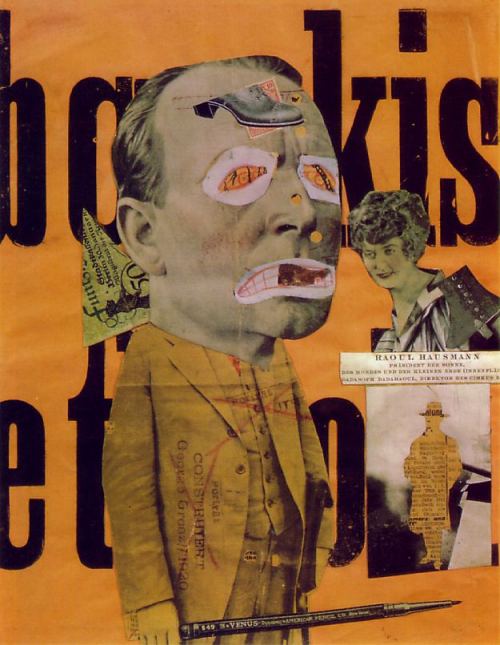
Raoul Hausmann, 1919 The Art Critic
Marcel Duchamp, Fountain, 1917
Marcel Duchamp, L.H.O.O.Q., 1919


DADA THEATRE

A conflict would exist between the various parts of the poetic reading, and this conflict was the desired result of the performance. The result would create a direct, irrational effect in the audience member. Only this irrational response is valid. According to Tzara, logic is a lie that doesn't work. 

For for article click here

PERFORMANCE VIDEO


Dada and Cabaret Voltaire