ABOUT
In the early 1900s, a group of young and rebellious Italian writers and artists emerged determined to celebrate industrialization. They were frustrated by Italy’s declining status and believed that the “Machine Age” would result in an entirely new world order and even a renewed consciousness. Filippo Tommaso Marinetti, the ringleader of this group, called the movement Futurism. Its members sought to capture the idea of modernity, the sensations and aesthetics of speed, movement, and industrial development.
A Manifesto
Marinetti launched Futurism in 1909 with the publication his “Futurist manifesto” on the front page of the French newspaper Le Figaro. The manifesto set a fiery tone. In it Marinetti lashed out against cultural tradition (passatismo, in Italian) and called for the destruction of museums, libraries, and feminism. Futurism quickly grew into an international movement and its participants issued additional manifestos for nearly every type of art: painting, sculpture, architecture, music, photography, cinema—even clothing.
The Futurist painters—Umberto Boccioni, Carlo Carrà, Luigi Russolo, Gino Severini, and Giacomo Balla—signed their first manifesto in 1910 (the last named his daughter Elica—Propeller!). Futurist painting had first looked to the color and the optical experiments of the late 19th century, but in the fall of 1911, Marinetti and the Futurist painters visited the Salon d’Automne in Paris and saw Cubism in person for the first time. Cubism had an immediate impact that can be seen in Boccioni’s Materia of 1912 for example. Nevertheless, the Futurists declared their work to be completely original.
Dynamism of Bodies in Motion
The Futurists were particularly excited by the works of late 19th-century scientist and photographer Étienne-Jules Marey, whose chronophotographic (time-based) studies depicted the mechanics of animal and human movement.
A precursor to cinema, Marey’s innovative experiments with time-lapse photography were especially influential for Balla. In his painting Dynamism of a Dog on a Leash, the artist playfully renders the dog's (and dog walker's) feet as continuous movements through space over time.
Entranced by the idea of the “dynamic,” the Futurists sought to represent an object’s sensations, rhythms and movements in their images, poems and manifestos. Such characteristics are beautifully expressed in Boccioni’s most iconic masterpiece, Unique Forms of Continuity in Space (see above).
The choice of shiny bronze lends a mechanized quality to Boccioni's sculpture, so here is the Futurists’ ideal combination of human and machine. The figure’s pose is at once graceful and forceful, and despite their adamant rejection of classical arts, it is also very similar to the Nike of Samothrace.
Politics & War
Futurism was one of the most politicized art movements of the twentieth century. It merged artistic and political agendas in order to propel change in Italy and across Europe. The Futurists would hold what they called serate futuriste, or Futurist evenings, where they would recite poems and display art, while also shouting politically charged rhetoric at the audience in the hope of inciting riot. They believed that agitation and destruction would end the status quo and allow for the regeneration of a stronger, energized Italy.
These positions led the Futurists to support the coming war, and like most of the group’s members, leading painter Boccioni enlisted in the army during World War I. He was trampled to death after falling from a horse during training. After the war, the members’ intense nationalism led to an alliance with Benito Mussolini and his National Fascist Party. Although Futurism continued to develop new areas of focus (aeropittura, for example) and attracted new members—the so-called “second generation” of Futurist artists—the movement’s strong ties to Fascism has complicated the study of this historically significant art.
Synopsis
The most important Italian avant-garde art movement of the 20th century, Futurism celebrated advanced technology and urban modernity. Committed to the new, its members wished to destroy older forms of culture and to demonstrate the beauty of modern life - the beauty of the machine, speed, violence and change. Although the movement did foster some architecture, most of its adherents were artists who worked in traditional media such as painting and sculpture, and in an eclectic range of styles inspired by Post-Impressionism. Nevertheless, they were interested in embracing popular media and new technologies to communicate their ideas. Their enthusiasm for modernity and the machine ultimately led them to celebrate the arrival of the First World War. By its end the group was largely spent as an important avant-garde, though it continued through the 1920s, and, during that time several of its members went on to embrace Fascism, making Futurism the only twentieth century avant-garde to have embraced far right politics.
Key Points
The Futurists were fascinated by the problems of representing modern experience, and strived to have their paintings evoke all kinds of sensations - and not merely those visible to the eye. At its best, Futurist art brings to mind the noise, heat and even the smell of the metropolis.
Unlike many other modern art movements, such as Impressionism and Pointillism, Futurism was not immediately identified with a distinctive style. Instead its adherents worked in an eclectic manner, borrowing from various aspects of Post-Impressionism, including Symbolism and Divisionism. It was not until 1911 that a distinctive Futurist style emerged, and then it was a product of Cubist influence.
The Futurists were fascinated by new visual technology, in particular chrono-photography, a predecessor of animation and cinema that allowed the movement of an object to be shown across a sequence of frames. This technology was an important influence on their approach to showing movement in painting, encouraging an abstract art with rhythmic, pulsating qualities.
Beginnings
Futurism began its transformation of Italian culture on February 20th, 1909, with the publication of the Futurist Manifesto, authored by writer Filippo Tommaso Marinetti. Umberto Boccioni (left) and Filippo Tommaso Marinetti in 1910 It appeared on the front page of Le Figaro, which was then the largest circulation newspaper in France, and the stunt signaled the movement's desire to employ modern, popular means of communication to spread its ideas. The group would issue more manifestos as the years passed, but this summed up their spirit, celebrating the "machine age", the triumph of technology over nature, and opposing earlier artistic traditions. Marinetti's ideas drew the support of artists Umberto Boccioni, Giacomo Balla, Gino Severini, and Carlo Carrà, who believed that they could be translated into a modern, figurative art which explored properties of space and movement. The movement initially centered in Milan, but it spread quickly to Turin and Naples, and over subsequent years Marinetti vigorously promoted it abroad.
Concepts and Styles
The Italian group was slow to develop a distinct style. In the years prior to the emergence of the movement, its members had worked in an eclectic range of styles inspired by Post-Impressionism, and they continued to do so. Severini was typical in his interest in Divisionism, which involved breaking down light and color into a series of stippled dots and stripes, and fracturing the picture plane into segments to achieve an ambiguous sense of depth. Divisionism was rooted in the color theory of the 19th century, and Pointillist work of painters such as Georges Seurat.
In 1911, Futurist paintings were exhibited in Milan at the Mostra d'arte libera, and invitations were extended to "all those who want to assert something new, that is to say far from imitations, derivations and falsifications." The paintings featured threadlike brushstrokes and highly keyed color that depicted space as fragmented and fractured. Subjects and themes focused on technology, speed, and violence, rather than portraits or simple landscapes. Among the paintings was Boccioni's The City Rises (1910), a picture which can claim to be the first Futurist painting by virtue of its advanced, Cubist-influenced style. Public reaction was mixed. French critics from literary and artistic circles expressed hostility, while many praised the innovative content.
Boccioni's encounter with Cubist painting in Paris had an important influence on him, and he carried this back to his peers in Italy. Nevertheless, the Futurists claimed to reject the style, since they believed it was too preoccupied by static objects, and not enough by the movement of the modern world. It was their fascination with movement that led to their interest in chrono-photography. Balla was particularly enthusiastic about the technology, and his pictures sometimes evoke fast-paced animation, with objects blurred by movement. As stated by the Technical Manifesto of Futurist Painting, "On account of the persistency of an image upon the retina, moving objects constantly multiply themselves; their form changes like rapid vibrations in their mad career. Thus a running horse has not four legs, but twenty, and their movements are triangular." Rather than perceiving an action as a performance of a single limb, Futurists viewed action as the convergence in time and space of multiple extremities.
Futurist artists in 1913; from left - Decio Cinti, Luigi Russolo, Armando Mazza, Filippo Tommaso Marinetti, Paolo Buzzi, and Umberto Boccioni
Later Developments
In 1913, Boccioni used sculpture to further articulate Futurist dynamism. Unique Forms of Continuity in Space (1913) exemplifies vigorous action as well as the relationship between object and environment. The piece was a breakthrough for the Futurist movement, but after 1913 the movement began to break apart as its members developed their own personal positions. In 1915, Italy entered World War I; by its end, Boccioni and the Futurist architect Antonia Sant'Elia perished. Following the war, the movement's center shifted from Milan to Rome; Severini continued to paint in the distinctive Futurist style, and the movement remained active in the 1920s, but the energy had passed from it.
Nevertheless, Futurism sparked important developments outside Italy. A synthesis of Parisian Cubism and Italian Futurism was particularly influential in Russia from around 1912 until 1920, inspiring artists including Kazimir Malevich, Liubov Popova, Natalia Goncharova and David Burliuk. The developments in Russia made the movement very distinct from the Italian strain, and different aspects of it are often described as Rayonist, or Cubo-Futurist. Cubo-Futurism was also an influence on English art, where it gave rise to the Vorticist movement, which embraced philosopher T.E. Hulme, poet Ezra Pound, and artists Christopher Nevinson, Wyndham Lewis, David Bomberg and Jacob Epstein. Although the impact of Italian Futurism was concentrated in the visual arts, it did inspire artists in other media: Vladimir Mayakovsky was important in developing a Futurist literature in Russia; the Italian architect Antonio Sant'Elia developed a Futurist architecture, and is said to have penned a manifesto on the subject (his designs may have influenced the sets of Ridley Scott's film Bladerunner (1982)); and Luigi Russolo shifted from painting to creating musical instruments, and later wrote the manifesto "the Art of Noises" (1913), which has been a significant reference point for avant-garde music ever since. Although much of the energy had left the movement by the 1920s, the Futurist aesthetic also became part of the mix of modernist styles that inspired Art Deco.
QUOTES
"We want to fight ferociously against the fanatical, unconscious and snobbish religion of the past, which is nourished by the evil influence of museums. We rebel against the supine admiration of old canvases, old statues and old objects, and against the enthusiasm for all that is worm-eaten, dirty and corroded by time; we believe that the common contempt for everything young, new and palpitating with life is unjust and criminal."
- Filippo Marinetti
"If we paint the phases of an uprising, the crowd bristling with fists and noisy cavalry assaults will be translated on the canvas into bands of lines corresponding to all the forces in conflict, following the painting's laws of general violence. These lines of force must envelop the spectator and carry him away; he himself must be in some way obliged to grapple with the figures in the picture. All the objects, according to physical transcendentalism, tend towards the infinite through their force-lines, to bring the work of art back to true painting. We interpret nature by presenting these lines on the canvas as the origins or prolongations of the rhythms which the objects impress on our sensibilities."
- Apollonio
MANIFESTO
We want to sing the love of danger, the habit of energy and rashness.
The essential elements of our poetry will be courage, audacity and revolt.
Literature has up to now magnified pensive immobility, ecstasy and slumber. We want to exalt movements of aggression, feverish sleeplessness, the double march, the perilous leap, the slap and the blow with the fist.
We declare that the splendor of the world has been enriched by a new beauty: the beauty of speed. A racing automobile with its bonnet adorned with great tubes like serpents with explosive breath ... a roaring motor car which seems to run on machine-gun fire, is more beautiful than the Victory of Samothrace.
We want to sing the man at the wheel, the ideal axis of which crosses the earth, itself hurled along its orbit.
The poet must spend himself with warmth, glamour and prodigality to increase the enthusiastic fervor of the primordial elements.
Beauty exists only in struggle. There is no masterpiece that has not an aggressive character. Poetry must be a violent assault on the forces of the unknown, to force them to bow before man.
We are on the extreme promontory of the centuries! What is the use of looking behind at the moment when we must open the mysterious shutters of the impossible? Time and Space died yesterday. We are already living in the absolute, since we have already created eternal, omnipresent speed.
We want to glorify war — the only cure for the world — militarism, patriotism, the destructive gesture of the anarchists, the beautiful ideas which kill, and contempt for woman.
We want to demolish museums and libraries, fight morality, feminism and all opportunist and utilitarian cowardice.
We will sing of the great crowds agitated by work, pleasure and revolt; the multi-colored and polyphonic surf of revolutions in modern capitals: the nocturnal vibration of the arsenals and the workshops beneath their violent electric moons: the gluttonous railway stations devouring smoking serpents; factories suspended from the clouds by the thread of their smoke; bridges with the leap of gymnasts flung across the diabolic cutlery of sunny rivers: adventurous steamers sniffing the horizon; great-breasted locomotives, puffing on the rails like enormous steel horses with long tubes for bridle, and the gliding flight of aeroplanes whose propeller sounds like the flapping of a flag and the applause of enthusiastic crowds.
For full Manifesto click here
ART
 |
| Natalia Goncharova, Cyclist, 1913 |
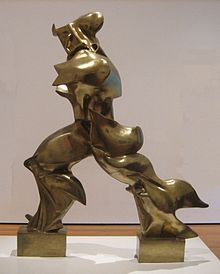 |
| Umberto Boccioni, Unique Forms of Continuity in Space (1913) |
 |
| Tullio Crali (1910-2000), Bombardamento Aereo, 1932 |
THEATRE
 |
| Examples of Futuristic Sintesi |
FROM THE MANIFESTO OF THE FUTURIST SYNTHETIC THEATRE
The dramatic 'synthesis', which will take the place of the traditional play, will be 'autonomous, unreal, and alogical'. Although elements drawn from reality will be used, they will be combined according to whim, and the synthesis will resemble nothing but itself. With color, forms, sounds and noises, it will, like the works of Futurist painters and musicians, assault the nerves.... The spectators will be made to 'forget the monotony of everyday life' through a 'labyrinth of sensations' characterized by the most exasperating originality combined in unexpected ways.
Anticipating the Surrealists, the Futurists declared that discoveries of the subconscious must be brought to the stage. The entertainment would 'symphonize' the feelings of the public, exploring and revealing those feelings in every possible way.

No comments:
Post a Comment