ABOUT
Dada emerged amid the brutality of World War I (1914–18)—a conflict that claimed the lives of eight million military personnel and an estimated equal number of civilians. This unprecedented loss of human life was a result of trench warfare and technological advances in weaponry, communications, and transportation systems.
For the disillusioned artists of the Dada movement, the war merely confirmed the degradation of social structures that led to such violence: corrupt and nationalist politics, repressive social values, and unquestioning conformity of culture and thought. From 1916 until the mid-1920s, artists in Zurich, New York, Cologne, Hanover, and Paris declared an all-out assault against not only on conventional definitions of art, but on rational thought itself. “The beginnings of Dada,” poet Tristan Tzara recalled, “were not the beginnings of art, but of disgust.”1 Dada’s subversive and revolutionary ideals emerged from the activities of a small group of artists and poets in Zurich, eventually cohering into a set of strategies and philosophies adopted by a loose international network of artists aiming to create new forms of visual art, performance, and poetry as well as alternative visions of the world. The artists affiliated with Dada did not share a common style or practice so much as the wish, as expressed by French artist Jean (Hans) Arp, “to destroy the hoaxes of reason and to discover an unreasoned order.”2
For Dada artists, the aesthetic of their work was considered secondary to the ideas it conveyed. “For us, art is not an end in itself,” wrote Dada poet Hugo Ball, “but it is an opportunity for the true perception and criticism of the times we live in.” Dadaists both embraced and critiqued modernity, imbuing their works with references to the technologies, newspapers, films, and advertisements that increasingly defined contemporary life. They were also experimental, provocatively re-imagining what art and art making could be. Using unorthodoxmaterials and chance-based procedures, they infused their work with spontaneity and irreverence. Wielding scissors and glue, Dada artists innovated withcollage andphotomontage. Still others explored games, experimental theater, and performance. A central figure, Marcel Duchamp, declared common, manufactured goods to be “readymade” artworks, radically challenging the notion of a work of art as something beautiful made by a technically skilled artist.
Participants claimed various, often humorous definitions of “Dada”—“Dada is irony,” “Dada is anti-art,” “Dada will kick you in the behind”—though the word itself is a nonsense utterance. As the story goes, the name Dada was either chosen at random by stabbing a knife into a dictionary, or consciously selected for a variety of connotations in different languages—French for “hobbyhorse” or Russian for “yes, yes.”
Synopsis
Dada was an artistic and literary movement that began in 1916 in Zurich, Switzerland. It arose as a reaction to World War I, and the nationalism, and rationalism, which many thought had brought war about. Influenced by ideas and innovations from several early avant-gardes - Cubism, Futurism, Constructivism, and Expressionism - its output was wildly diverse, ranging from performance art to poetry, photography, sculpture, painting and collage. Dada's aesthetic, marked by its mockery of materialistic and nationalistic attitudes, proved a powerful influence on artists in many cities, including Berlin, Hanover, Paris, New York and Cologne, all of which generated their own groups. The movement is believed to have dissipated with the arrival of Surrealist in France.
Key Ideas
Dada was born out of a pool of avant-garde painters, poets and filmmakers who flocked to neutral Switzerland before and during WWI.
The movement came into being at the Cabaret Voltaire in Zurich in February 1916. The Cabaret was named after the eighteenth century French satirist, Voltaire, whose play Candide mocked the idiocies of his society. As Hugo Ball, one of the founders of Zurich Dada wrote, "This is our Candide against the times."
So intent were members of Dada on opposing all the norms of bourgeois culture that the group was barely in favor of itself: "Dada is anti-Dada," they often cried.
Dada art varies so widely that it is hard to speak of a coherent style. It was powerfully influenced by Futurist and Expressionist concerns with technological advancement, yet artists like Hans Arp also introduced a preoccupation with chance and other painterly conventions.
Beginnings
Disgusted by the nationalism that had sped the course to war in 1914, the Dadaists were always opposed to authoritarianism, and to any form of group leadership or guiding ideology. Their interests lay primarily in rebelling against what they saw as cultural snobbery, bourgeois convention, and political support for the war. Dada events, including spontaneous readings, performances, and exhibitions, had been taking place for three years at Hugo Ball's Cabaret Voltaire before Tristan Tzara claimed to have invented the word Dada, in his Dada Manifesto of 1918. Various explanations have been floated for the name of the group, but the most common is that put forward by co-founder Richard Huelsenbeck, who said that he found the name by plunging a knife at random into a dictionary. It is a colloquial French term for a hobbyhorse, yet it also echoes the first words of a child, and these suggestions of childishness and absurdity appealed to the group, who were keen to put a distance between themselves and the sobriety of conventional society. It also appealed to them because it might mean the same (and nothing) in all languages - as the group was avowedly internationalist.
Concepts and Styles
The cross-cultural possibilities of language were at the core of the movement's belief in freedom of expression: Hugo Ball, in his early Cabaret Voltaire readings of sound-poems, underscored this by deconstructing words into a series of guttural sounds meant to be universally comprehended. Likewise, visual artists such as Hans Arp, used abstract compositions made by chance to express patterns in nature which were expressive regardless of one's cultural background.
Overall, Dada artworks present an intriguing paradox in that they seek to demystify artwork in the populist sense but nevertheless remain cryptic enough to allow the viewer to interpret works in a variety of ways. Like the Cubists, some Dadaists portrayed people and scenes representationally in order to analyze form and movement. Other artists, like Kurt Schwitters, practiced abstraction to express the metaphysical essence of their subject matter. Both modes sought to deconstruct daily experience in challenging, rebellious ways. Key to understanding Dada works lies in reconciling the seemingly silly, slapdash styles with the stringent anti-war message. Tristan Tzara especially fought the assumption that Dada was a statement; yet Tzara and his fellow artists became increasingly agitated by politics and sought to incite a similar fury in Dada audiences.
The Spread of Dada
The end of Dada in Zurich followed the Dada 4-5 event in April 1919 that ultimately caused a riot. Soon after this, Tristan Tzara traveled to Paris, where he met André Breton, and began formulating the theories that Breton would eventually call Surrealism. Dadaists did not mean to self-consciously declare micro-regional movements, but as it happened, the spread of Dada throughout various European cities and into New York can be attributed to a few key artists, and each city in turn influenced the aesthetics of their respective Dada groups. In Berlin, Club Dada ran from 1918 to 1923, and included attendees such as artists Johannes Baader, George Grosz, Hannah Höch, and Raoul Hausmann. Closer to a war zone, the Berlin Dadaists made politically satirical paintings and collages that featured wartime imagery, government figures, and political cartoon clippings recontextualized into biting commentaries. In Hanover, the Merz group, including Kurt Schwitters, made art that reflected inspiration from Constructivism. Schwitters' works in particular examines modernist preoccupations with shape and color. In Cologne, Hans Arp made breakthroughs in collage during his collaborations with Max Ernst. And in Paris, under the influence of figures such as Francis Picabia and Tzara, the movement took on a more dandyish tone, before collapsing into internal infighting and ceding to Surrealism.
Further Developments
As Arp, Ernst, and Tzara went to Paris, they were instrumental in bringing Dada interests in free expression and the deconstruction of both forms and conventional ideas to those who would become Surrealists. Dada's tradition of irrationality led directly to the Surrealist love for fantasy and expression of the imaginary. Artists such as Max Ernst are considered members of both Dada and Surrealism since their works acted as a catalyst in ushering in a new era of art based on the unconscious.
Duchamp and New York
Marcel Duchamp provided a crucial creative link between the Zurich Dadaists and Parisian proto-Surrealists, like Breton. The Swiss group considered Marcel Duchamp's readymades to be Dada artworks, and they appreciated Duchamp's humor and refusal to define art. Duchamp, along with Picabia, Man Ray, and Guillaume Apollinaire, had already been in New York as early as 1917, and Duchamp served as a critical interlocutor, bringing the notion of anti-art to New York. One of his most important pieces, The Large Glass or Bride Stripped Bare by her Bachelors, Even, was begun in New York in 1915 (and completed in 1923) and is considered to be a major Dada milestone for its depiction of a strange, erotic drama using abstract, mechanical forms. Duchamp's disdain for bourgeois convention was shared by all members of Dada. Though he was not a Surrealist, he helped to curate exhibitions in New York that showcased both Dada and Surrealist works.
QUOTES
"Dada does not mean anything.. We read in the papers that the Negroes of the Kroo race call the tail of the sacred cow: dada. A cube, and a mother, in certain regions of Italy, are called: Dada. The word for a hobby-horse, a children's nurse, a double affirmative in Russian and Rumanian, is also: Dada."
- Tristan Tzara, Dada Manifesto
"Words emerge, shoulders of words, legs, arms, hands of words. Au, oi, uh. One shouldn't let too many words out. A line of poetry is a chance to get rid of all the filth that clings to this accursed language, as if put there by stockbrokers' hands, hands worn smooth by coins. I want the word where it ends and begins. Dada is the heart of words."
- Hugo Ball's manifesto, read at Zunfthaus zur Waag on July 14th, 1916
"We attempted perfection; we wanted an object to be without flaw, so we cut the papers with a razor, pasted them down meticulously, but it buckled and was ruined... that is why we decided to tear prewrinkled paper, so that in the finished work of art imperfection would be an integral part, as if at birth death were built in."
- Hans Arp from The Artist in his Studio by Alexander Liberman
MANIFESTO
Every product of disgust capable of becoming a negation of the family is Dada; a protest with the fists of its whole being engaged in destructive action: Dada; know ledge of all the means rejected up until now by the shamefaced sex of comfortable compromise and good manners: Dada; abolition o/ logic, which is the dance of those impotent to create: Dada; of every social hierarchy and equation set up for the sake of values by our valets: Dada: every object, all objects, sentiments, obscurities, apparitions and the precise clash of parallel lines are weapons for the fight: Dada; abolition of memory: Dada; abolition of archaeology: Dada; abolition of prophets: Dada; abolition of the future: Dada; absolute and unquestionable faith in every god that is the immediate product of spontaneity: Dada; elegant and unprejudiced leap from a harmony to the other sphere; trajectory of a word tossed like a screeching phonograph record; to respect all individuals in their folly of the moment: whether it be serious, fearful, timid, ardent, vigorous, determined, enthusiastic; to divest one's church of eve ry useless cumbersome accessory; to spit out disagreeable or amorous ideas like a luminous waterfall, or coddle them—with the extreme satisfaction that it doesn't matter in the least—with the same intensity in the thicket of core's soul pure of insects for blood well-born, and gilded with bodies of archangels. Freedom: Dada Dada Dada, a roaring of tense colors, and interlacing of opposites and of all contradictions, grotesques, inconsistencies: LIFE
For full Manifesto click here
ART

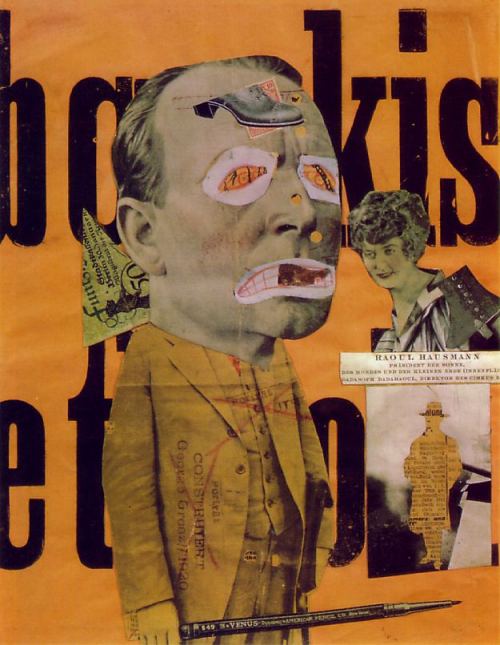 |
| Raoul Hausmann, 1919 The Art Critic |
 |
| Marcel Duchamp, Fountain, 1917 |
 |
| Marcel Duchamp, L.H.O.O.Q., 1919 |
DADA THEATRE
A conflict would exist between the various parts of the poetic reading, and this conflict was the desired result of the performance. The result would create a direct, irrational effect in the audience member. Only this irrational response is valid. According to Tzara, logic is a lie that doesn't work.
For for article click here
PERFORMANCE VIDEO
Dada and Cabaret Voltaire

No comments:
Post a Comment