Samuel Becket.Net
On Theatre of the Absurd
"If Existentialism was the philosophical model of a universe that has lost its meaning and purpose….-then the Theatre of the Absurd was one way of facing up to that universe. If there is a sin of life "it is not perhaps so much to despair of life, as to hope for another life and to lose sight of the implacable grandeur of this one"
"Absurd Drama spoke to a deeper level of the audiences awareness -its staging was usually very funny and very terrifying, pushing the audience forward, then confusing them, compelling a personal assessment of their reactions, and offering opposites that multiply in their minds -IT CHALLENGED THE AUDIENCE TO MAKE SENSE OF NON-SENSE, TO FACE THE PREDICAMENT OF LIFE CONSCIOUSLY RATHER THE FEEL IT VAGUELY, AND PERCEIVE, WITH LAUGHTER, ITS FUNDAMENTAL ABSURDITY."
On Becket
"Beckett has consistently refuse to explain his work -one of his rare utterances was the expression:
"nothing is more real than nothing" for to know nothing is nothing, not to want to know anything likewise, but to be beyond knowing anything, that is when peace enters into the soul of the incurious seeker.
The nature of his work could best be described as enigmatic and pessimistic.
His plays exhibit a lack of plot and character"
"nothing is more real than nothing" for to know nothing is nothing, not to want to know anything likewise, but to be beyond knowing anything, that is when peace enters into the soul of the incurious seeker.
The nature of his work could best be described as enigmatic and pessimistic.
His plays exhibit a lack of plot and character"
ON Waiting for Godot
"Waiting For Godot is a play/poem about a world without any divinity, a world in which man waits and hopes for something to give a meaning to his life, and relieve him of the absurdity of a death that will terminate all. But he waits in vain, and so our life is as meaningless as our deaths.
It is a monstrous paradox that an individual's life is an eternity while it lasts, but it is less than an instant in regard to cosmic time. Consciousness of the paradox is all important-but the consciousness by which we are aware of our individual existence is continually at risk from heart failure or mental breakdown. At best our consciousness is held in the prison of "time". In the prison, only forward motion is possible, and we delude ourselves that we progress towards some sort of ultimate goal….this ultimate goal [ in the case of "Waiting for Godot"] becomes anything that helps us bear our existence."
It is a monstrous paradox that an individual's life is an eternity while it lasts, but it is less than an instant in regard to cosmic time. Consciousness of the paradox is all important-but the consciousness by which we are aware of our individual existence is continually at risk from heart failure or mental breakdown. At best our consciousness is held in the prison of "time". In the prison, only forward motion is possible, and we delude ourselves that we progress towards some sort of ultimate goal….this ultimate goal [ in the case of "Waiting for Godot"] becomes anything that helps us bear our existence."
THE THEATRE OF THE ABSURD: THE WEST AND THE EAST
"'The Theatre of the Absurd' is a term coined by the critic Martin Esslin for the work of a number of playwrights, mostly written in the 1950s and 1960s. The term is derived from an essay by the French philosopher Albert Camus. In his 'Myth of Sisyphus', written in 1942, he first defined the human situation as basically meaningless and absurd. The 'absurd' plays by Samuel Beckett, Arthur Adamov, Eugene Ionesco, Jean Genet, Harold Pinter and others all share the view that man is inhabiting a universe with which he is out of key. Its meaning is indecipherable and his place within it is without purpose. He is bewildered, troubled and obscurely threatened."
"absurd plays assumed a highly unusual, innovative form, directly aiming to startle the viewer, shaking him out of this comfortable, conventional life of everyday concerns. In the meaningless and Godless post-Second-World-War world, it was no longer possible to keep using such traditional art forms and standards that had ceased being convincing and lost their validity. The Theatre of the Absurd openly rebelled against conventional theatre. Indeed, it was anti-theatre. It was surreal, illogical, conflictless and plotless. The dialogue seemed total gobbledygook. Not unexpectedly, the Theatre of the Absurd first met with incomprehension and rejection."
"In trying to burst the bounds of logic and language the absurd theatre is trying to shatter the enclosing walls of the human condition itself. Our individual identity is defined by language, having a name is the source of our separateness - the loss of logical language brings us towards a unity with living things. In being illogical, the absurd theatre is anti-rationalist: it negates rationalism because it feels that rationalist thought, like language, only deals with the superficial aspects of things. Nonsense, on the other hand, opens up a glimpse of the infinite. It offers intoxicating freedom, brings one into contact with the essence of life and is a source of marvellous comedy."
For full article click here
Absurdist Theatre: A Resource Guide
"Esslin defined the Absurdist movement as any form of theater that "strives to express its sense of the senselessness of the human condition and the inadequacy of the rational approach by the open abandonment of rational devices and discursive thought." (Esslin 24) Indeed, the Theater of the Absurd is often characterized by a lack of logically-constructed plots, senseless characterization, and a very persistent awareness of the limits of the stage itself as a creator of worlds. The movement is made up of only five playwrights, according to Esslin: Samuel Beckett of Ireland, the most well-known, Eugene Ionesco of Romania and France, Jean Genet of France, Arthur Adamov of Russia, and Harold Pinter of England, (although many of them wrote in French, and so are considered among other French literature). While other plays can be categorized as absurdist, these five playwrights have supplied the bulk of the canon."
For full resource guide click here
The Theatre of the Absurd by Martin Esslin
This article was written by the man that coined this genre of theatre. It is a very helpful resource when studying Theatre of the Absurd.
For full article click here
Major Playwrights
 |
| Samuel Beckett |
 |
| Eugene Ionesco |
 |
| Jean Genet |
 |
| Arthur Adamov |
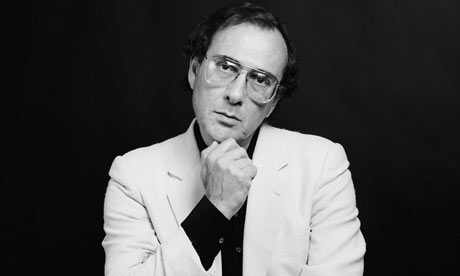 |
| Harold Pinter |
Waiting For Godot by Samuel Beckett
Copy of Play
A full text free copy of Waiting for Godot can be found online here.
Reviews
New York Times, 1956
"you can expect witness to the strange power this drama has to convey the impression of some melancholy truths about the hopeless destiny of the human race."
For full review click here
Theatre Journal, 1999
"Waiting for Godot consists almost wholly of eloquence deployed against the torments of waiting."
For full review click here.
The Observer, 2009
"For the text is the perfect statement of futility and redemption, of lying in the gutter but looking at the stars, and audiences who seek the pattern of their own fears will find it for themselves."
For full review click here.
The Arts Fuse, 2013
"it accentuates the aspects of the human spirit that make due with scraps, that survives the unthinkable with a residue of resilience."
For full review click here.
What are they waiting for? Who is Godot?
"It's fairly obvious Godot can be anything you want. The great thing Beckett did was to say there is such a thing as metaphorical theatre. Godot's a metaphor for religions, philosophy, belief, every kind of thing you can think of, but it never arrives. We do die, however - this we know. But Sam didn't talk about death, he didn't give lectures about what his play meant."
Production Photos
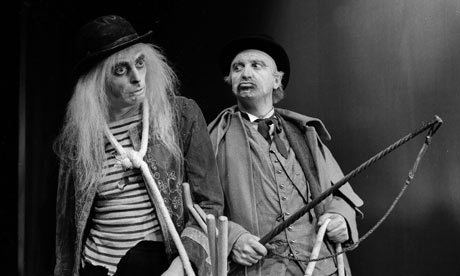 |
| Original Production, 1956 |
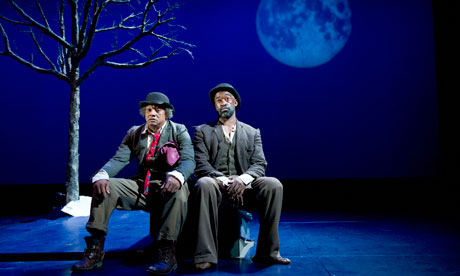 |
| West Yorkshire Playhouse, 2012 |
 |
| McNeese State University, 2010 |
 |
| SCENA Theatre, 2008 |

No comments:
Post a Comment