Sunday, September 29, 2013

A Doll's House


Synopsis

It is holiday time and Nora Helmer has been busily preparing for the festive occasion.  Her husband Torvald is a lawyer who is about to take over the position of director bank where he works. They have three small children and what looks like a bright future ahead of them. Nora, however, has been harboring a secret that could unravel their apparently happy family life.

Early in their marriage Torvald became very ill, and doctors advised him to stay in a warmer climate to hopefully cure his infection.  As a young couple with very little money, Nora knew that this trip would save Torvald’s life, so she had to secretly get hold of the funds for the journey. She borrowed money from Krogstad, a lawyer who had been a classmate of Torvald`s. In order to secure the loan, she she forged her dying father`s signature. Torvald recovered, but never knew of his wife’s efforts. Ever since Nora has used part of the housekeeping money in order to pay back the loan with interest.  She has also taken on small jobs to earn some money herself.

An old friend of Nora’s, Mrs. Linde, has come to town to look for work, and Nora begs Torvald to give her a job at the bank. In order to do this kindness for her friend, it means that Torvald must dismiss Krogstad from his position at the bank.  In desperation Krogstad goes to Nora and threatens to tell Torvald about the loan and the forgery unless he is allowed to keep his job. Nora is in anguish, but believes that in Torvald’s love for her, he will sacrifice himself and take full responsibility for what she has done, if he learns the truth behind her past actions.

Nora considers asking Dr. Rank, a friend of the family, for the money, but when he declares his love for her, she finds it impossible to ask him. Torvald finds out what has happened, and reacts with anger and loathing, showing no willingness to take responsibility for Nora’s forgery. Mrs. Linde, who was in love with Krogstad in the past, convinces him to change his mind and withdraw his threats.  Even though the danger to their tidy life has passed, Nora begins to see that her marriage is not what she thought it was, and a confrontation with Torvald she determines that her most important and only duty is to herself where she must go out into the world on her own to try and grow up, and she leaves her husband and children.

Copy of Play

Marxist Internet Archive


Productions of Play

 Royal Theatre in Copenhagen, Denmark in 1879

Betty Hennings as Nora


Emil Poulsen as Helmer

Original Broadway 

Palmer's Theatre in 1889 

Latest Broadway

A Doll's House, Belasco Theatre, 1997

Off-Broadway

Theatre Four in 1963

The Old Globe

A Doll's House, The Old Globe, 2013

Production Photos

1950s version at Northern Stage in New Castle, England in 2008

Modern Version at Long Wharf Theatre in New Haven, Connecticut in 2010


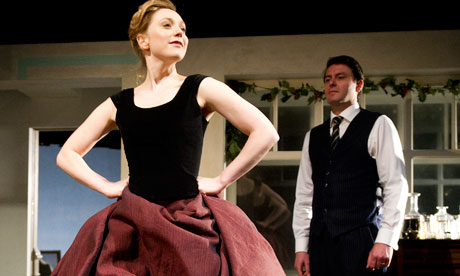
Duke of York's Theatre in London, England in 2013

Why A Doll's House by Henrik Ibsen is more relevant than ever by Susanna Rustin

"There is something timeless about it," Morahan says, "which is what's so shocking. You try to keep it in its box of 19th-century Scandinavia, but the things Ibsen writes mean it ceases to be about a particular milieu and becomes about marriage (or partnership) and money. These are universal anxieties, and it seems from talking to people that it resonates in the most visceral way, especially if they are or have been in a difficult relationship. Someone said to me the other night, 'That's the play that broke my parents' marriage up.' It shines a very harsh light on the messy heart of relationships, and how difficult it can be to be honest with another human being even if you love them."

To read full article click here

Henrik Ibsen

Henrik Ibsen

Biography

HENRIK IBSEN (1828-1906)


This article was originally published in A Short History of the Drama. Martha Fletcher Bellinger. New York: Henry Holt & Company, 1927. pp. 317-22.

IN the entire history of literature, there are few figures like Ibsen. Practically his whole life and energies were devoted to the theater; and his offerings, medicinal and bitter, have changed the history of the stage. The story of his life -- his birth March 20, 1828, in the little Norwegian village of Skien, the change in family circumstances from prosperity to poverty when the boy was eight years old, his studious and non-athletic boyhood, his apprenticeship to an apothecary in Grimstad, and his early attempts at dramatic composition -- all these items are well known. His spare hours were spent in preparation for entrance to Christiania University, where, at about the age of twenty, he formed a friendship with Björnson. About 1851 the violinist Ole Bull gave Ibsen the position of "theater poet" at the newly built National Theater in Bergen -- a post which he held for six years. In 1857 he became director of the Norwegian Theater in Christiania; and in 1862, with Love's Comedy, became known in his own country as a playwright of promise. Seven years later, discouraged with the reception given to his work and out of sympathy with the social and intellectual ideals of his country, he left Norway, not to return for a period of nearly thirty years. He established himself first at Rome, later in Munich. Late in life he returned to Christiania, where he died May 23, 1906.

IBSEN'S PLAYS


The productive life of Ibsen is conveniently divided into three periods: the first ending in 1877 with the successful appearance of The Pillars of Society; the second covering the years in which he wrote most of the dramas of protest against social conditions, such as Ghosts; and the third marked by the symbolic plays, The Master Builder and When We Dead Awaken. The first of the prose plays, Love's Comedy (1862) made an impression in Norway, and drew the eyes of thoughtful people to the new dramatist, though its satirical, mocking tone brought upon its author the charge of being a cynic and an athiest. The three historical plays, or dramatic poems, Brand, Emperor and Galilean, and Peer Gynt, written between 1866 and 1873, form a monumental epic. These compositions cannot be considered wholly or primarily for the stage; they are the poetic record of a long intellectual and spiritual struggle. In Brand there is the picture of the man who has not found the means of adjustment between the mechanical routine of daily living and the deeper claims of the soul; in Emperor and Galilean is a portrayal of the noblest type of pagan philosophy and manhood, illustrated in the Emperor Julian, set off against the ideals of the Jewish Christ; and in Peer Gynt is a picture of the war within the soul of a man in whom are no roots of loyalty, faith, or steadfastness.

When The Young Men's League was produced, the occasion, like the first appearance of Hernani, became locally historic. The play deals with political theories, ideas of liberty and social justice; and in its presentation likenesses to living people were discovered, and fierce resentments were aroused. The tumult of hissing and applauding during the performance was so great that the authorities interfered. The Pillars of Society, Ibsen's fifteenth play, was the first to have a hearing throughout Europe. It was written in Munich, where it was performed in the summer of 1877. In the autumn it was enacted in all the theaters of Scandinavia, whence within a few months it spread over the continent, appearing in London before the end of the year. The late James Huneker, one of the most acute critics of the Norwegian seer, said: "The Northern Aristophanes, who never smiles as he lays on the lash, exposes in The Pillars of Society a varied row of white sepulchres. . . . There is no mercy in Ibsen, and his breast has never harbored the milk of human kindness. This remote, objective art does not throw out tentacles of sympathy. It is too disdainful to make the slightest concession, hence the difficulty in convincing an audience that the poet is genuinely humain."

The Pillars of Society proved, once and for all, Ibsen's emancipation, first, from the thrall of romanticism, which he had pushed aside as of no more worth than a toy; and, secondly, from the domination of French technique, which he had mastered and surpassed. In the plays of the second period there are evident Ibsen's most mature gifts as a craftsman as well as that peculiar philosophy which made him the Jeremiah of the modern social world. In An Enemy of the People the struggle is between hypocrisy and greed on one side, and the ideal of personal honor on the other; in Ghosts there is an exposition of a fate-tragedy darker and more searching even than in Oedipus; and in each of the social dramas there is exposed, as under the pitiless lens of the microscope, some moral cancer. Ibsen forced his characters to scrutinize their past, the conditions of the society to which they belonged, and the methods by which they had gained their own petty ambitions, in order that they might pronounce judgment upon themselves. The action is still for the most part concerned with men's deeds and outward lives, in connection with society and the world; and his themes have largely to do with the moral and ethical relations of man with man.

In the third period the arena of conflict has changed to the realm of the spirit; and the action illustrates some effort at self-realization, self-conquest, or self-annihilation. The Master Builder and When We Dead Awaken must explain themselves, if they are to be explained at all; for they are meaningless if they do not light, in the mind of the reader or spectator, a spark of some clairvoyant insight with which they were written. In them are characters which, like certain living men and women, challenge and mystify even their closest friends and admirers. Throughout all the plays there are symbols -- the wild duck, the mill race, the tower, or the open sea -- which are but the external tokens of something less familiar and more important; and the dialogue often has a secondary meaning, not with the witty double entendre of the French school, but with suggestions of a world in which the spirit, ill at ease in material surroundings, will find its home.

It is significant that Ibsen should arrive, by his own route, at the very principles adopted by Sophocles and commended by Aristotle -- namely, the unities of time, place and action, with only the culminating events of the tragedy placed before the spectator. After the first period he wrote in prose, abolishing all such ancient and serviceable contrivances as servants discussing their masters' affairs, comic relief, asides and soliloquies. The characters in his later dramas are few, and there are no "veils of poetic imagery."

IBSEN'S MORAL IDEALS


The principles of Ibsen's teaching, his moral ethic, was that honesty in facing facts is the first requisite of a decent life. Human nature has dark recesses which must be explored and illuminated; life has pitfalls which must be recognized to be avoided; and society has humbugs, hypocrisies, and obscure diseases which must be revealed before they can be cured. To recognize these facts is not pessimism; it is the moral obligation laid upon intelligent people. To face the problems thus exposed, however, requires courage, honesty, and faith in the ultimate worth of the human soul. Man must be educated until he is not only intelligent enough, but courageous enough to work out his salvation through patient endurance and nobler ideals. Democracy, as a cure-all, is just as much a failure as any other form of government; since the majority in politics, society, or religion is always torpid and content with easy measures. It is the intelligent and morally heroic minority which has always led, and always will lead, the human family on its upward march. Nevertheless, we alone can help ourselves; no help can come from without. Furthermore -- and this is a vital point in understanding Ibsen -- experience and life are a happiness in themselves, not merely a means to happiness; and in the end good must prevail. Such are some of the ideas that can be distilled from the substance of Ibsen's plays.

On the plane of practical methods Ibsen preached the emancipation of the individual, especially of woman. He laid great stress upon the principle of heredity. He made many studies of disordered minds, and analyzed relentlessly the common relationships -- sister and brother, husband and wife, father and son. There is much in these relationships, he seems to say, that is based on sentimentalism, on a desire to dominate, on hypocrisy and lies. He pictured the unscrupulous financier, the artist who gives up love for the fancied demands of his art, the unmarried woman who has been the drudge and the unthanked burden-bearer -- all with a cool detachment which cloaks, but does not conceal, the passionate moralist.

From the seventh decade of the last century to his last play in 1899, the storm of criticism, resentment, and denunciation scarcely ceased. On the other hand, the prophet and artist which were united in Ibsen's nature found many champions and friends. In Germany he was hailed as the leader of the new era; in England his champion, William Archer, fought many a battle for him; but in the end no one could escape his example. Young playwrights learned from him, reformers adopted his ideas, and moralists quoted from him as from a sacred book. His plays scorched, but they fascinated the rising generation, and they stuck to the boards. Psychologists discovered a depth of meaning and of human understanding in his delineation of character. He did not found a school, for every school became his debtor. He did not have followers, for every succeeding playwright was forced in a measure to learn from him.


Overview of Realism

Modern Theatre, Realism


The movement that has had the most pervasive influence on modern theatre is realism, the trends toward which began with the rejection of neoclassical form through 18th-century sentimental dramas and comedies and continued in the artistic rebelliousness of Romantic drama. Likeness to life is realism's goal, and although it has sought to create a drama free of conventions and abstractions, it bears as many contrivances as any other dramatic style. Realism did achieve a reassessment of all aspects of production, however, and was conceived as a kind of laboratory where the "scientific method" would allow an "objective" presentation of the nature of relationships or the ills of society. Every aspect of the theatre was fashioned into apparent lifelikeness. Its evidence offered from the surface of life, however, prompts its viewers to delve into the mysteries below such surfaces and into the complex human lives it portrays. Henrik Ibsen launched the movement in 1879 with a trio of plays whose psychological detail and social concern other playwrights soon began to emulate across Europe.
As a concurrent but essentially independent movement, naturalism was an attempt to present human reality without any appearance of dramatic convention. Basing their ideas in the approach of scientists of nature, such as Charles Darwin, the naturalists conceived of human beings as biological phenomena, entirely determined by their heredity and environment. Naturalist plays, therefore, reject the elements of conventional dramatic structure, such as climaxes and conclusions. Instead, the theatre was to offer an unadulterated "slice of life."
Although Henrik Ibsen's dramas brought realistic theatre to prominence, those of Anton Chekhov became the most carefully crafted examples of its style. By creating deeply complex character relationships and developing the plots and themes between the lines, Chekhov created intricate plays that are still performed today. Looking in depth at his drama, The Three Sisters, reveals the qualities of his technique that were a revelation to audiences when the play was first performed by the Moscow Art Theatre in 1901.
Since the United States is a relatively young country, its major dramatic development took place during realism's rise to prominence. Eugene O'Neill, America's first master dramatist, as well as Arthur Miller, Tennessee Williams, and other mid-twentieth-century playwrights wrote works that reveal the social and personal characteristics and issues of America. Such works helped make realism the basic language of the American stage today.
Source

The Modern Theatre


One of theatre's greatest periods continues today. The modern period and its drama were shaped by world-changing forces, such as industrial-technological revolution, democratic revolutions, and an intellectual revolution that would disrupt earlier conceptions of time, space, the divine, human psychology, and social order. As a result, a theatre of challenge and experimentation emerged.
Realism, the movement with the most pervasive and long-lived effect on modern theatre, was conceived as a laboratory in which the ills of society, familial problems, and the nature of relationships could be "objectively" presented for the judgment of impartial observers. Its goal, of likeness to life, demanded that settings resemble their prescribed locales precisely and seem like rooms from real life in which one wall have been removed. The playwright Henrik Ibsen initiated the realistic period with plays focused on contemporary, day-to-day themes that skillfully reveal both sides of a conflict through brilliantly capturing psychological detail. Anton Chekhov, in Russia, would bring the form to its stylistic apogee with plays whose even minor characters seem to breathe the air we do and in which the plots and themes are developed primarily between the lines. An independent but concurrent movement, naturalism, would be an even more extreme attempt to dramatize human reality without the appearance of dramaturgical shaping. While realist plays would address well-defined social issues, naturalist plays offered a simple "slice of life" free from dramatic convention. With the same reverence for nature, the human being was conceived as a mere biological phenomenon whose behavior was determined by heredity and environment.
Source

Understanding Realism


Realism was a theatre movement that came to the forefront in the early 20th Century. It  was the theory of Naturalism put into practice. It aimed to take a ‘slice of life', as such, and reproduce it on the stage. The proscenium arch acted as the fourth wall of a room, and the audience looked into this ‘laboratory-type' set up and examined what may happen to a real person.

The movement was interested in looking at the complexity of the human psyche; analysing why it is humans act the way we do, thus the main challenge of the actor was to be as realistic and as close to life as possible.

Now that we have had a very basic look at realism, we can understand that its premise was to take a ‘slice of life' and reproduce it on stage, as close to life as possible. To achieve this, certain guidelines or principles were established. For example, actors did not address the audience, and instead were trained to ‘become' the character they were playing: to feel their emotion and believe that they were living the characters life. The theory being ‘I feel it, therefore I am it.'

The majority of mainstream theatre today works on the principles of realism.

Source

Realism

  • Shows life as it really is
  • "Problem Plays"- shed light on problems in life and society
  • There is no right/wrong, bad/good, moral/immoral
  • Average everyday people dealing with real life problems
  • Ending is rarely happy
  • Required actors to become the characters
  • Set is usually realistic as well, often a "box set" with the fourth wall removed

Box Set

Example of a box set from "The Mousetrap"

Saturday, September 28, 2013

Theatre Before Realism


In the years leading up to realism, theatre was very black and white. There were good guys and bad guys and the bad guys always got what was coming to them in the end. The world of plays was made up of certain rules like their must be moral justice by the end of the play, the bad guys and good guys must be clearly defined, characters act with decorum (according to their class), and they must be orderly. Towards the end of this period, some theatre people started to break out of this world ruled by rules and create works that completely defied them. This was very scandalous for the time and in many instances completely unaccepted. But this paved the way for realism.